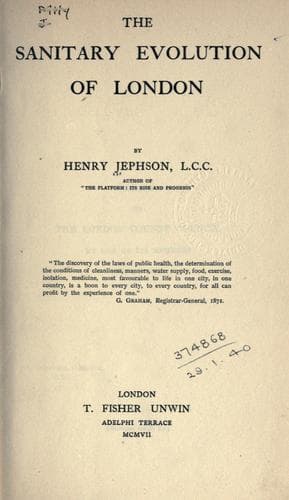
The Sanitary Evolution of LondonJephson, Henry (Henry Lorenzo)
History
The Sanitary Evolution of London
Jephson, Henry (Henry Lorenzo)
Public health -- England -- London
Though, indirectly, the schools of the Board were having considerable
effect upon the physical well-being of the rising generation, it cannot
be said that the School Board had utilised its vast opportunities
for improving the general health. By instruction, by influence, it
might have done so much, might have moulded the physical future of
generations. But education was always much more in the minds of the
Board than health, though the two might well have been considered
together, and without health education is of little use.
The Board in their "Final Report" endeavoured to offer an explanation
of their inaction.
"It has always been a question how far the Board are authorised to
spend public money on the medical care of children. On the one hand
suggestions have been made for the inspection of their teeth, and the
treatment of cases of anæmic condition and arrested development. On the
other hand a legal opinion has been expressed that the Board are not
entitled to do anything, or to take any measures except such as spring
from the fact that the attendance of the children is compulsory. On
this account it has been thought right to take action only in those
cases in which on account of contagious disease, it is necessary to
exclude children from school."[186]
Even the sanitary condition of the schools does not appear to have been
well looked after.
In January, 1890, one of the Committees submitted a report to the
Board, on which the resolution was passed--
"That the Committee be authorised to thoroughly examine the whole
of the drainage of any school of the Board where they may think it
necessary," &c.
The drainage was subsequently examined. In 181 schools the drainage was
all right. In 292 of the schools re-drainage was required. For how long
that fertile source of disease had been scattering its evil germs among
the tens of thousands of children attending these insanitary schools,
no information is available.
In 1890, just twenty years after its formation, the Board appointed a
Medical Officer, and he gave only a portion of his time to the work.
"Before 1891 there was no attempt on the part of the Board to prevent
the spread of infectious diseases by precautionary measures being
adopted in the school."[187]
In 1895 the Medical Officer of Health for Paddington wrote:--
"School teachers should be required to inform the Sanitary Authority of
any special amount of illness which may occur among the scholars. Half
a school may be away through sickness if the disease be not a notified
one, but no information of such fact comes to the Sanitary Authority."
And in 1896 he wrote:--
"The past year had emphasised the need of definite instructions to
school teachers to keep the Medical Officers of Health informed of the
existence of infectious disease among their pupils. It is surmised
that there were upwards of 2,000 cases of measles in the parish in the
earlier part of the year."
And "measles is the most fatal disease of childhood."
Public-domain text, read in full here on John Shaqi.
Reviews
Reviews
No reviews yet
Be the first to share your thoughts on this work.
Elsewhere in the archive
Join the Discussion
Join the discussion
Sign in to leave a comment or review.
Sign InorCreate an account