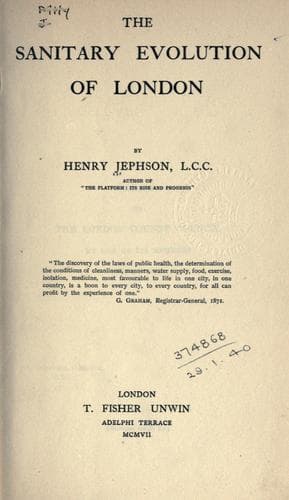
The Sanitary Evolution of LondonJephson, Henry (Henry Lorenzo)
History
The Sanitary Evolution of London
Jephson, Henry (Henry Lorenzo)
Public health -- England -- London
That the water supply should be under the control and management of the
municipality had long been advocated, but though hundreds of County and
Municipal Authorities in Great Britain--many of them not the hundredth
part of the size of London--had a Municipal Water Supply, that great
boon was denied to London. The reform was vigorously pressed by the
central representative body of London--the London County Council--and
after several Royal Commissions of Inquiry, Parliament dealt with the
subject in 1902. But the manner of dealing with it was unfortunate and
retrograde.
A new public Board--the Metropolitan Water Board--was established
for the purpose of acquiring, by purchase, for the inhabitants of
London, and of certain areas outside London, the undertakings of the
eight Metropolitan Water Companies, and for managing and carrying on
the supply of water. The great bulk of the purchase money was to be
provided by the ratepayers of London, and the great bulk of the debt to
be a charge on the rateable property of London.
The Board was to consist of 66 members, 14 of whom were to be nominated
by the London County Council, 31 by the Metropolitan Borough Councils
and the City Corporation, and the remaining 21 by the authorities of
localities outside London hitherto supplied by the Companies.
The Board, therefore, was not a representative body directly elected
by the ratepayers or electors of London, but was constructed, on the
discredited precedent of the Metropolitan Board of Works, of delegated
instead of elected members; and though the people of London were
emancipated from the control of trading Water Companies, they got
in their place a body over which they can exercise no direct, and
therefore very little actual, control.
The new Board was constituted in the spring of 1903, and took over the
undertakings of the Water Companies on the 24th of June, 1904, at the
cost to the ratepayers of London of not much less than £40,000,000, a
sum immensely higher than that at which they could have been acquired
many years before.
And inasmuch as the Board can call upon the ratepayers of London to
make good any deficiency of income resulting from their management,
the unsatisfactory result is the establishment in London of a new
indirectly-elected public body vested with enormous financial powers
affecting the interests of the ratepayers of London, and yet but little
responsible to public control.
The third of the three important Acts, the Education London Act, was
passed in 1903, and carried in its bosom possibilities of the most
far-reaching benefits to the health and physical welfare of future
generations.
By this Act the London School Board was abolished, and its duties
transferred to the London County Council, which was constituted the
Education Authority for London.
Public-domain text, read in full here on John Shaqi.
Reviews
Reviews
No reviews yet
Be the first to share your thoughts on this work.
Elsewhere in the archive
Join the Discussion
Join the discussion
Sign in to leave a comment or review.
Sign InorCreate an account