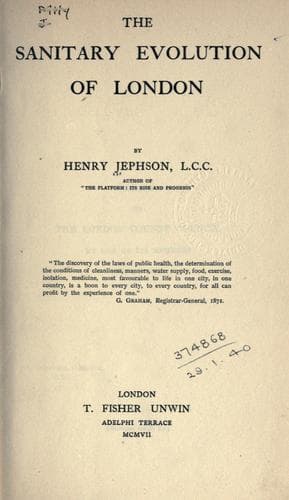
The Sanitary Evolution of LondonJephson, Henry (Henry Lorenzo)
History
The Sanitary Evolution of London
Jephson, Henry (Henry Lorenzo)
Public health -- England -- London
Also in 1902 the Cremation Act, which empowered burial authorities to
provide and maintain crematoria, and empowered the Secretary of State
to make regulations as to the conditions under which cremation might
take place.
And to complete the tale of sanitary legislation since 1900, a few
reforms were secured by sections in the annual General Powers Acts
which the London County Council obtained from Parliament. Among these
was one rather important one.
In 1894 the duty of supervising and regulating the common
lodging-houses in London, which hitherto had been performed by the
Commissioner of Police, was transferred to the London County Council.
In that year 654 such houses were on the register, and the authorised
number of lodgers was close upon 30,000 persons. In 1902 the Council
obtained powers for the annual licensing of such houses. These larger
powers enabled the Council to improve the sanitary condition of
many of these houses. The supervision of these houses has been most
satisfactorily carried out, and has been of immense value in securing
sanitary abodes for the miserable people who frequent them, and in
diminishing what would otherwise doubtless often be a source of
infection to the community.
The sanitary evolution of London having begun a little before the
middle of the nineteenth century, the figures of the censuses of 1851
and 1901 afford the means for measuring many of the great changes which
have taken place in the intervening period.
And a comparison of the state of those things which most affect the
public health at these two dates enables a reliable deduction to be
drawn as to whether there has been evolution to a higher level of
public health, or a retrogression; and, if the former, the progress
which that evolution has made.
In 1851 the population of London was 2,362,236. In 1901 it had reached
4,536,541. And when to this is added the fact that all through the
intervening years so enormous a mass of people has been cooped up in
an area of 117 square miles, and that at the present time there are
over 4,500,000 within that small area, the multiplicity of the matters
decisively influencing their health and physical well being, and the
vastness of the issues at stake, come into vivid light.
As has been often said, the very basis or foundation of the sanitation
of a city is an efficient system of drainage. Without it sanitation is
impossible.
Public-domain text, read in full here on John Shaqi.
Reviews
Reviews
No reviews yet
Be the first to share your thoughts on this work.
Elsewhere in the archive
Join the Discussion
Join the discussion
Sign in to leave a comment or review.
Sign InorCreate an account