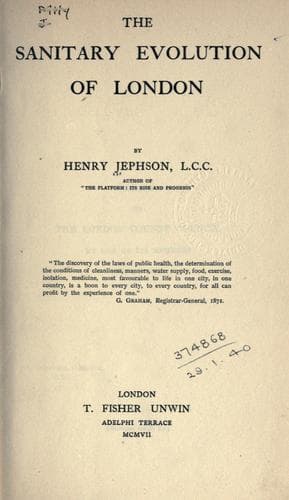
The Sanitary Evolution of LondonJephson, Henry (Henry Lorenzo)
History
The Sanitary Evolution of London
Jephson, Henry (Henry Lorenzo)
Public health -- England -- London
What the main drainage of London was up to 1858 has been described
in the earlier chapters of this book. In effect, nothing less than
an entire system had then to be designed and constructed to provide
London with this first essential. This was done, and the result was
of immediate and enormous benefit to London, and ever since then the
maintenance and extension and improvement of this work has received the
solicitous attention of the Central Authority. Originally designed for
3,500,000 people, it had, as London grew, to be considerably enlarged
and extended, and as some of the districts outside the boundaries of
London were allowed by Parliament to drain into the London sewers,
still larger works had to be constructed. And now the system serves a
resident population of, in round figures, 5,500,000 people spread over
an area of about 140 square miles. It comprises close upon 90 miles of
great intercepting and outfall sewers, 176 miles of main sewers, and 26
miles of large relief sewers, constructed for the special purpose of
conveying storm-water away.
This, however, was but part of the provision which had to be made.
During the _régime_ of the Metropolitan Board of Works, more than 1,100
miles of new sewers were laid by Vestries and District Boards in their
respective districts, and since the creation of the London County
Council of 1888, further additions of 1,516 miles have been made,
making a total of over 2,600 miles.
All this work was essential to enable a proper system of house drainage
to be carried out, and as the drainage of houses into the local sewers
was compulsory, the general system of drainage was thus rounded off or
completed.
The change effected thereby in the conditions of life in London has
been remarkable. There are no longer open ditch-sewers polluting the
air with their pestilential abominations; no longer streets without
sewers, and houses without the possibility of drainage.
In the Report of the County Council for 1902-3, prepared by the Clerk
of the Council, there is given a calculation of what these works
annually accomplish.
"The flow of sewage during the year, namely 87,556 million gallons,
represents a canal 24 feet wide with a depth of 9 feet, running day and
night at the rate of 2 feet per second; or it may be considered as
equivalent to a lake of 44 square miles, or about one-third of the area
of the county of London, with a depth of 11-1/5 feet."
To the efficiency and thoroughness of the present system is primarily
due the greatly improved condition of the public health of London as
compared with 1855.
Water was another of the absolute necessities of existence and of
sanitation. An ample supply of good water is essential for health; and
the numerous outbreaks of typhoid fever which in recent years have
occurred in England with a heavy death-roll, testify to the dangers
incurred by bad water, and the necessity for the utmost care being
taken to secure its being pure and uncontaminated.
Public-domain text, read in full here on John Shaqi.
Reviews
Reviews
No reviews yet
Be the first to share your thoughts on this work.
Elsewhere in the archive
Join the Discussion
Join the discussion
Sign in to leave a comment or review.
Sign InorCreate an account