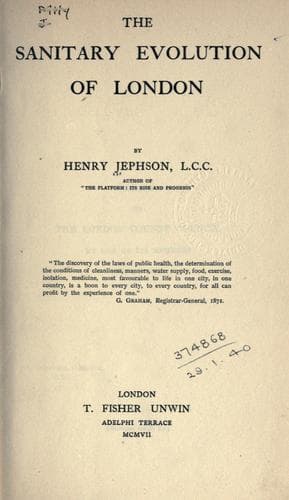
The Sanitary Evolution of LondonJephson, Henry (Henry Lorenzo)
History
The Sanitary Evolution of London
Jephson, Henry (Henry Lorenzo)
Public health -- England -- London
Various Commissioners, such as the Commissioners of Baths and
Washhouses, Library Commissioners, and Burial Boards, have ceased to
be; their powers being now exercised by the Borough Councils.
The important changes in the local government of the metropolis have
mainly been in the Central Authorities, whose sphere of duties extends
over the whole area of London.
The principal Central Authority, the London County Council, which
superseded the Metropolitan Board of Works in 1889, instead of being
indirectly elected as was that body, is a directly elected body,
elected by and representative of the whole electorate of London. Its
duties and powers have undergone extension and increase; the latest
material addition to them being its appointment as the Education
Authority for London.
In 1867, owing to the default of the Vestries and District Boards to
make provision of rate-supported hospitals for paupers suffering from
infectious or contagious disease, a Central Authority--the Metropolitan
Asylums Board--constituted on the indirectly elected system, with
considerable powers to spend money which had to be provided out of the
rates of the metropolis, was created to do that work.
In 1870 another central body was created, the London School Board,
to deal with the elementary education of the children of London, and
though not a health authority, its work was closely associated with the
public health. It also possessed the widest powers for spending money,
which had to be provided out of the rates of the metropolis. It was a
directly elected body, but elected on a system peculiar to itself, and
one which in great measure removed it from any financial public control.
By an Act of Parliament in 1903 the London County Council was made the
Education Authority for London, and the work of the School Board was
transferred to it.
To the two existing central authorities was added, in 1903, another
wholly gratuitous central local authority, the Metropolitan Water
Board, an indirectly elected body with ultimate rating power over the
metropolis.
There is a third sphere of government in matters pertaining to the
public health--namely, that occupied by the State. It is charged
with many duties connected with the public health, and is in close
relationship with the various central and local authorities in London.
It has undergone large changes since the middle of the last century.
At that time some of the powers possessed by the State Government in
health matters were exercised by one of the Secretaries of State.
Others, for some years, through the General Board of Health appointed
by the Government. In 1858, when that Board ceased to exist, some of
its powers were transferred to the Privy Council, others lapsed to the
local sanitary authorities.
Public-domain text, read in full here on John Shaqi.
Reviews
Reviews
No reviews yet
Be the first to share your thoughts on this work.
Elsewhere in the archive
Join the Discussion
Join the discussion
Sign in to leave a comment or review.
Sign InorCreate an account