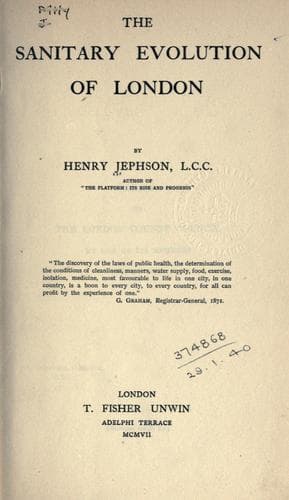
The Sanitary Evolution of LondonJephson, Henry (Henry Lorenzo)
History
The Sanitary Evolution of London
Jephson, Henry (Henry Lorenzo)
Public health -- England -- London
In 1905, 415,000 tons of meat reached the Central Smithfield Market,
of which 2,128 tons were seized as being diseased and unsound. At
Billingsgate, 211,600 tons of fish were delivered, of which 674 tons
were condemned. And there were 28 wharves and warehouses in the City
where tinned food and tinned meat and vegetables were received. 173
tons were seized. All these places were daily inspected.
This, however, was only a portion of the food which reached London. The
responsibility for inspecting food in other parts of the metropolis
rested (under the Public Health (London) Act of 1891) with the various
Sanitary Authorities, and the reports of the Medical Officers of Health
contain accounts of inspections by them, and of the seizure of meat,
fish, poultry, rabbits, tinned food, vegetables, eggs, and sweetmeats,
and of prosecutions, and of a few convictions. And many other articles
of food were, under the Food and Drugs Act of 1875-99, also liable to
inspection so as to secure that they should not be adulterated; so that
theoretically, and in a very great measure actually, provision exists
for protecting the people of London from adulterated articles of food,
and from food unfit for human consumption.
All this is an immense advance upon the time when there were no laws
against the sale of unsound or adulterated food.
But there is great room for improvement, for the inspection and means
of prevention are far from adequate to secure the protection of the
public from this danger; indeed, the existing system of government for
dealing successfully with this most important element in the well-being
of the people is very defective.
The experiences of the past sixty years or so in London have abundantly
shown how great is the extent to which the public health is dependent
upon the system of local government in existence at the time, and upon
the administration of the laws relating to the public health by those
authorities.
The considerable changes which have taken place in the fifty years
since the creation of a Central Authority, the Metropolitan Board of
Works, have been described.
So far as regarded the local authorities over the separate areas into
which London was divided, the "City" remains practically as it was,
with the exception of the addition to its sphere of action of the
important duties of Port Sanitary Authority, and such further powers as
the exigencies of the times required, and certain changes consequent
upon the creation of the London County Council.
In the metropolis the other local sanitary authorities instead of being
Vestries and District Boards--43 in number--are now Municipal Borough
Councils--28 in number--with some larger powers, including wide powers
of rating.
The Poor Law Guardians, also with wide powers of rating, have remained
much as they were, their sphere of work being a definitely limited one.
Public-domain text, read in full here on John Shaqi.
Reviews
Reviews
No reviews yet
Be the first to share your thoughts on this work.
Elsewhere in the archive
Join the Discussion
Join the discussion
Sign in to leave a comment or review.
Sign InorCreate an account