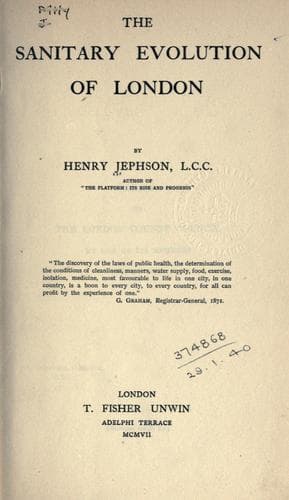
The Sanitary Evolution of LondonJephson, Henry (Henry Lorenzo)
History
The Sanitary Evolution of London
Jephson, Henry (Henry Lorenzo)
Public health -- England -- London
Twelve years later, namely in 1847, the Towns Improvement Act was
passed, by which towns of much smaller size were given facilities
for obtaining considerable powers of local government. By it general
sanitary provisions were framed, which, with the sanction of
Parliament, might be applied in any town for the management by the
local authorities of the supply of water, of drainage, of the paving,
cleansing, and lighting of the streets, and the prevention of fires;
and for the regulation of buildings, of slaughter-houses, of public
baths, and of the interment of the dead.
But even this more limited but still liberal system of local government
was not extended to London, and once more the metropolis was excluded.
The "City" did not wish to extend its own borders, and the authorities
of the "City" viewed with dislike the idea of the creation at their
very gates of local bodies which might develop into formidable rivals.
And so "greater London" was left by successive governments and by
Parliament to scramble along as best she could, and to suffer.
And just as there was no local government so were there practically
no laws safeguarding the sanitary condition of the people except the
temporary and imperfect ones provided by the Nuisances Removal and
Diseases Prevention Acts of 1848, and such very limited protection as
the common law afforded.
The Public Health Act of 1848--a sanitary code in itself--was an Act
for England and Wales alone. The benefits it conferred were refused to
London; and, as a consequence, the masses of her people were doomed to
continue in circumstances of the utmost misery; year by year tens of
thousands of her citizens were sent to an unnecessarily early death,
and ten times their number were made to undergo diseases which even
then were recognised as preventable.
And all the time that she was thus left without a local government,
without any permanent sanitary laws, other forces were at work
inflicting ever-widening evil, and intensifying already existing evils.
The population had increased by leaps and bounds, and the increasing
trade of London had brought great numbers of workmen to the metropolis.
The necessity for offices and warehouses had led to the substitution of
such houses for houses previously used as residences.
And so the growing population was forced to herd ever closer together,
houses were packed thicker and thicker, and, in the central districts,
every available spot of ground was built upon. And the overcrowding of
human beings in those houses, and all the attendant ills, increased
countless-fold. And the result was unparalleled, indescribable,
unspeakable misery of the industrial and working classes, and of the
lower and poorer orders.
Not merely years, but generations of neglect and indifference on the
part of the governing classes had multiplied and intensified in London
every evil to which the poorer classes of a nation are liable.
Public-domain text, read in full here on John Shaqi.
Reviews
Reviews
No reviews yet
Be the first to share your thoughts on this work.
Join the Discussion
Join the discussion
Sign in to leave a comment or review.
Sign InorCreate an account