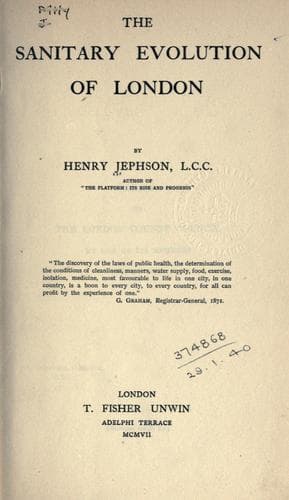
The Sanitary Evolution of LondonJephson, Henry (Henry Lorenzo)
History
The Sanitary Evolution of London
Jephson, Henry (Henry Lorenzo)
Public health -- England -- London
"Bricklayers are spreading the webs and meshes of houses with such
fearful rapidity in every direction that people are being gradually
confined within narrow prisons only open at the top for the admission
of what would be air if it were not smoke.
"Suburban open spaces are being entombed in brick and mortar mausoleums
for the suffocation as well as for the accommodation of an increasing
populace."[64]
Thus in Islington there were 13,500 houses in 1851, and 20,700 in 1861;
in Kensington 6,100 in 1851, and 9,400 in 1861.
But what evoked comment was, that the evils of one sort or another
connected with the crowding of houses together were being perpetuated.
"Not only is it to be deplored," wrote the Medical Officer of Health
for Whitechapel, "that the houses in most of the poor neighbourhoods
are already too closely packed together, but the evil is increasing:
for wherever there is a vacant spot of ground, more houses are built,
thereby still further diminishing the healthiness of those already
existing" (1860-1).
From Hampstead--still but little built on--came a complaint of "the
tendency among builders to cover the new ground as thickly and at as
little cost as practicable."
In Wandsworth "houses were erected and new streets formed without due
regard to sanitary requirements, and in situations where good drainage
seems impossible."
In Fulham, "cottages out of number were constructed in the excavations
of old brick fields with the soft refuse of bricks, habitations run in
swamps and quagmires, and their foundations three parts of the year
sopped with surface water."
Efficient sewerage was so manifestly the basis of all wise sanitation
that the want of sewers, and the abominable condition of those which
existed, were general subjects of complaint.
The Strand boasted of being "one of the best sewered districts in the
metropolis," which, however, was not saying much for it. And in St.
Giles' the sewerage was stated to be good, and "much above the average
of the town."
But such reports were quite exceptional. In Hackney, the principal
sewer was the former Hackney Brook, which, from the increase of the
population, and the drainage from other sewers, houses, cemeteries,
and cattle-market, had become a foul open ditch--with very trifling
exception wholly uncovered--and "emitting pestiferous noxious effluvia."
In St. Marylebone, the sewers, themselves insufficient for the
requirements of a growing population (1858), were, in many cases, so
shallow as to cause rather than remove evil, for in certain places they
flooded the basements, and in more than one house was witnessed the
curious spectacle of the daily use of pumps to remove the foul liquids,
as in leaking ships.
Public-domain text, read in full here on John Shaqi.
Reviews
Reviews
No reviews yet
Be the first to share your thoughts on this work.
Elsewhere in the archive
Join the Discussion
Join the discussion
Sign in to leave a comment or review.
Sign InorCreate an account