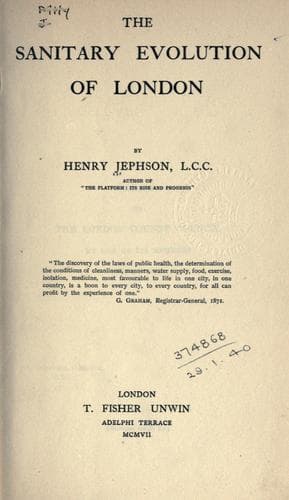
The Sanitary Evolution of LondonJephson, Henry (Henry Lorenzo)
History
The Sanitary Evolution of London
Jephson, Henry (Henry Lorenzo)
Public health -- England -- London
In Paddington (1857-8), "the principles of good town drainage were
completely ignored. The sewers were those which had been constructed
at intervals, previous to 1846, in a piecemeal and unsatisfactory
manner, as the thoroughfares were formed, without any regard to the
requirements of the adjoining streets." The general direction of these
sewers was "extremely defective. Numbers of them have a fall towards
the summit or highest level of the street through which they pass; the
bottoms are very irregular, running up and down and forming successions
of hills and hollows."
In Fulham, there existed scarcely the trace of a main sewer, open
sewers and filthy ditches, conveying some part of the sewage to the
river, the rest remaining in the cesspools.
In Hammersmith, not only were sewers and ditches in a most fearful
state of nuisance, but there was also "a morass of several acres in
extent, having no outlet, which received the sewage from a large
area, the noxious emanations from which must be regarded as highly
detrimental to health."
On the south side of the river matters were still worse. The greater
number of the southern districts were situate nearly on the same level
as high-water mark, if not indeed below it, and they differed from the
other districts of London in their marshy character, their low level,
and in the want of proper drainage dependent on that low level. The
whole district suffered under the effects of a tide-locked, pent-up
system of sewerage.
In Greenwich, a very large number of streets were without main sewers.
In St. Mary, Newington, "the great fact meeting us at every turn has
been the large number of streets without main sewers therein."
Rotherhithe, which lay from four to seven feet below high water, was
exceptionally bad. The largest portion of the parish had no drainage
whatever. There were about fifteen miles of open ditches which had
been converted into open sewers, called in some official documents
"Stygian pools," and serving "the double debt to pay of watercourse
and cesspool." Among the ditches "one of the foulest in the whole
neighbourhood of London" was the King's Mills stream, about one and
a half miles long, which had not been cleansed for ten years. The
sewer in Paradise Row was "in reality not a sewer," but "an elongated
cesspool a mile in length," and during twenty hours daily it was
waterlogged. The very boundary line of the parish for a long distance
was "a wide, filthy, black, open sewer."
In part consequent on the lack of sewers, house drainage was either
non-existent or fearfully defective. In every part of the metropolis
the evil was evident.
In Clerkenwell the "drainage was either none or very imperfect.
Numberless houses do not drain into the sewers." In St.
Martin-in-the-Fields, "in the old streets and courts the drainage was
the same as it was when the houses were built, some as far back as the
reign of Elizabeth, and many in that of Charles I."
Public-domain text, read in full here on John Shaqi.
Reviews
Reviews
No reviews yet
Be the first to share your thoughts on this work.
Elsewhere in the archive
Join the Discussion
Join the discussion
Sign in to leave a comment or review.
Sign InorCreate an account