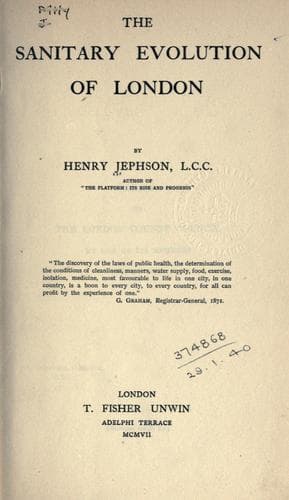
The Sanitary Evolution of LondonJephson, Henry (Henry Lorenzo)
History
The Sanitary Evolution of London
Jephson, Henry (Henry Lorenzo)
Public health -- England -- London
In St. George-in-the-East (1856), "it is astonishing how few houses
have availed themselves of the sewers."
In Paddington, "the condition of the house-drains is far worse than
that of the sewers. They include every possible variety of geometrical
construction, from a circle to a square. Some have fallen in; others
are choked with filth."
In Lewisham (1856-7), "in several places there are reported to be
nuisances of the usual character ... cesspools, no water, &c.--stinking
ditches filled with sewage which can get no further--every abomination,
and people apparently doing what they pleased as regards getting rid of
their filth."
Nor was it only in the poorer parts of London that the house-drainage
was bad. In St. James' (Westminster) the Medical Officer of Health
wrote (1861):--
"For the last two or three years the worst cases of neglected drainage
have not been in houses inhabited by the poor, but in those inhabited
by the wealthier classes of the community. It is to me frequently a
matter of great astonishment to find how regardless those classes are,
whose circumstances can command every comfort of life, of the sources
of disease and death. This is not only seen in neglect of attention to
drainage, but also in the neglect of ventilation."
Nor was care being taken to provide drainage even to houses which were
in course of erection. The Medical Officer of Health for Hackney, which
was a growing district, reported (1858-9):--
"Building operations have recently been carried on with considerable
activity, numerous new streets have been laid out and built on....
Unfortunately there have not been, and there are not at the present
time, any means whereby the construction of proper drainage works could
be enforced before the erection of buildings along the line of new
streets, and the consequence has been that, to avoid the heavy cost
of constructing effective sewers, the drainage works have been almost
everywhere but very imperfectly carried out, and in many cases not even
a brick has been laid for these purposes."
The internal condition of the houses was very bad.
In Clerkenwell, where there were over 7,000 houses, many of them were
"quite unfit for human habitation"; not more than one-third were "in
a satisfactory state." In Bethnal Green there were "disease-inviting
houses"; in Whitechapel, such was the bad condition of many of the
2,734 houses which were inspected, that "they ought to be condemned as
unfit for human habitation."
In St. George-in-the-East, "the sanitary condition of the
dwelling-houses is deplorable."
Lambeth contained a greater number of inhabited houses than any other
parish in the metropolis--nearly 22,000. The Medical Officer of Health,
after the very limited inquiry possible within the first year of work,
reported the unwholesome condition of 1,638 of them.
Public-domain text, read in full here on John Shaqi.
Reviews
Reviews
No reviews yet
Be the first to share your thoughts on this work.
Elsewhere in the archive
Join the Discussion
Join the discussion
Sign in to leave a comment or review.
Sign InorCreate an account