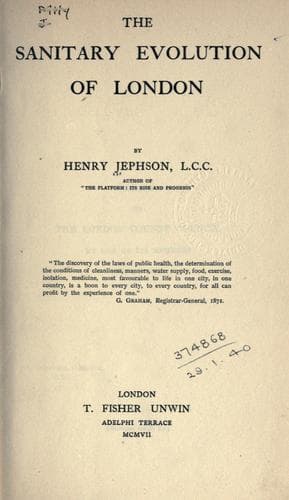
The Sanitary Evolution of LondonJephson, Henry (Henry Lorenzo)
History
The Sanitary Evolution of London
Jephson, Henry (Henry Lorenzo)
Public health -- England -- London
"If a poor man gets married he is pretty sure to have a large family
of children, and at the present rate of mortality several will die of
zymotic disease.
"Hence, when a death occurs, the living and the dead must be together
in the same room; the living must eat, drink, and sleep beside a
decomposing corpse, and this in usually a small, ill-ventilated room,
overheated by a fire required for cooking, and already filled with the
foul emanations from the bodies of the living and their impure clothes.
"This is an everyday occurrence in Clerkenwell, and constitutes a
formidable evil."
So great was the pressure for accommodation of some sort or kind, that
even the cellars and kitchens in the basements of the houses were
occupied as dwelling-places and overcrowded.
In St. James', "the worst feature of the overcrowding was the very
common practice of residence in cellars or kitchens. In the majority of
cases the places are quite unfit for human residence.
"... A cellar in St. Giles'," wrote the Medical Officer of Health for
that district in 1858, "has been the by-word for centuries to express
a wretched habitation unworthy of humanity.
"Dating from the time of Charles I., the underground dwellings of our
district attained the acme of their miserable notoriety from the pen
and pencil of Fielding and Hogarth.
"... The Building Act of 1844 contained stringent clauses against
the use of such rooms unless they possessed requisites of area and
ventilation, such as were out of the question in the cellars of St.
Giles'.
"The Metropolis Management Act (1855) repeated the prohibition of 1844,
and in defence of the public health the Board have lately put this
statute in force. This has been done without compromise. As separate
habitations for occupation by human beings at night 'a cellar in St.
Giles'' is no longer to exist."
This was written in 1858, but in the following year he wrote:--
"The profit derived from letting the basement of these houses as
dwelling-rooms was too strong a temptation for their owners, and many
of the kitchens were let again as soon as the Inspector had reported
them emptied."
In the Strand (1856) underground rooms and kitchens were inhabited
"notwithstanding that District Surveyors are numerous, and that the
Metropolitan Building Act is in operation."
In Westminster, "an examination of various portions of the parishes
shows that large numbers of the poor occupy premises whereby they are
not only deprived of the required quantity of air, but being situated
below the level of the street, the ventilation is insufficient, the
rooms generally damp, and when closed for the night the atmosphere is
perfectly insufferable--mostly kitchens and cellars, evidently never
intended to be used as sleeping rooms" (1858-9).
The causes of the dreadful overcrowding which existed so extensively
were many and deep-seated--springing from the very roots of the social
and economic system. And they were of great force and widespread in
effect.
Public-domain text, read in full here on John Shaqi.
Reviews
Reviews
No reviews yet
Be the first to share your thoughts on this work.
Elsewhere in the archive
Join the Discussion
Join the discussion
Sign in to leave a comment or review.
Sign InorCreate an account