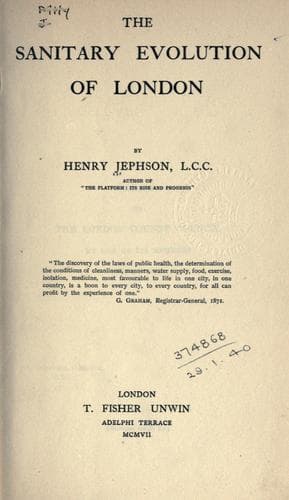
The Sanitary Evolution of LondonJephson, Henry (Henry Lorenzo)
History
The Sanitary Evolution of London
Jephson, Henry (Henry Lorenzo)
Public health -- England -- London
The cause to which the various authorities and Medical Officers of
Health directly attributed it was the one immediately before their
eyes--namely, the pulling down of houses which hitherto had afforded
shelter, of a sort, to the people.
As the Medical Officer of Health for St. Olave, Southwark, said
(1860-1):--
"To effect street improvements--to build warehouses, or for some other
purpose--the habitations of the working classes are broken up without
any provision being made for them elsewhere. They are therefore driven
by necessity to crowd into other houses in the same neighbourhood
perhaps already overcrowded."
An actual illustration was the case reported by the Medical Officer of
Health for Limehouse:--
"The London Dock Company have, for the purpose of enlarging and
improving their docks, pulled down not less than 400 houses in the
parish of Shadwell, the homes of not fewer than 3,000 persons of the
poorer classes.
"... The neighbouring parishes are now suffering from an augmentation
of their already overcrowded population."
The District Board of St. Saviour, Southwark, stated that the evil of
overcrowding "can scarcely be exaggerated, whether it be regarded in a
physical, mental, or moral aspect."
The principal of the causes are:--
"(1) The arbitrary power exercised by railway companies in ejecting the
labouring classes from their homes without any obligation to provide
for their domestic convenience.
"(2) The existing law of (poor law) removal, any break in the three
years' residence in the parish rendering them liable to removal to
other distant parishes."
The latter had, however, most probably, but very small effect.
A great cause was that described by the Medical Officer of Health for
Shoreditch:--
"There is a constant and rapid flow of population into Shoreditch. It
is in this circumstance that I see one of the most alarming dangers to
the health of the district.
"The area does not enlarge, and yet year after year dense crowds of
human beings are packed and squeezed into that limited area. The
growth of the population has far outstripped the growth of the house
accommodation.
"The immense majority of the immigrants are precisely of that class
which most largely increases the dangers of disease by thickening the
population. You are largely burdened with the pauperism of other and
wealthier districts. The burden is doubly grievous; for it taxes your
property, your labour, and gives strength to the elements of disease
amongst you.
"It is probable that there is no spot in London more crowded with life
than many places in Holywell or St. Leonard's.
"Typhus--a disease more terrible than cholera--has made itself at home
in the parish."
And the Medical Officer of Health for Fulham wrote (1857):--
"... The daily necessities of the labourer's family draw so heavily
on his earnings as to leave only a very small sum for the payment of
rent, and hence the most limited house accommodation is sought for and
endured...."
Public-domain text, read in full here on John Shaqi.
Reviews
Reviews
No reviews yet
Be the first to share your thoughts on this work.
Elsewhere in the archive
Join the Discussion
Join the discussion
Sign in to leave a comment or review.
Sign InorCreate an account