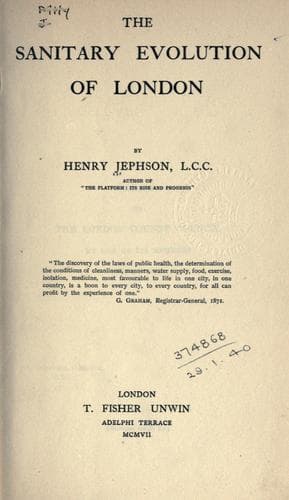
The Sanitary Evolution of LondonJephson, Henry (Henry Lorenzo)
History
The Sanitary Evolution of London
Jephson, Henry (Henry Lorenzo)
Public health -- England -- London
Mention is made, however, of the overcrowding which existed in another
large section of the community--namely, the overcrowding of children
in some of the schools. The Medical Officer of Health for Whitechapel
reported that there was much overcrowding, and in his report for 1857
gave some instances of it in his district:--
18, _Charlotte Street_.--In a room 8 feet high, 7 wide, 10 long: 14
children and 1 mistress = 37 cubic feet each.
17, _Charlotte Street_.--Matters still worse; the room was underground;
10 feet wide, 10 long; about 7 feet high; 35 children and 1 mistress =
20 cubic feet each.
2, _Gorelston Street_.--672 cubic feet; 31 children and 1 mistress = 20
cubic feet each.
In such cases the atmosphere must have been a rapid poison to those
breathing it.
There was another powerful contributory cause to the general
insanitation of London, namely, the defilement of the atmosphere which
people had to breathe. As one of the Medical Officers of Health said
some years later:--
"We should remember that the air we breathe is as much our food as the
solids we eat and the liquids we drink, and as much care should be
taken that it is free from adulteration."
London was already the greatest manufacturing city in the world, and
the great volumes of smoke proceeding from the numerous factories
undoubtedly deteriorated the quality of the air. But it was the noxious
vapours proceeding from the various processes of manufacture classified
as "noxious trades" which rendered the atmosphere in many parts of
London dangerous to health.
Many were the descriptions given of the almost intolerable evils. Thus
the Medical Officer of Health for Rotherhithe reported in 1857:--
"In the mile length of Rotherhithe Street there are no less than nine
factories for the fabrication of patent manure, that is to say, nine
sources of foetid gases. The process gives out a stench which has
occasioned headache, nausea, vomiting, cough, &c. Many complaints have
been made by the inhabitants."
From St. Mary, Newington, "the terrible effluvium of bone-boiling is
freely transmitted over the district."
Some manufacture in a yard in Clerkenwell (1856-7), which had existed
until lately, was "one of the most abominable, exceeding anything that
the imagination could picture."
And in every parish or district of London there were slaughter-houses.
"There are too many slaughter-houses in crowded districts," wrote the
Medical Officer of Health for St. Pancras (1856-7). "It is impossible
that slaughtering of animals can be carried on amongst a dense
population without proving more or less injurious to the public health.
"This it does in several ways--by occasioning the escape of effluvia
from decomposing animal refuse into the air and along the drains, and
by the numerous trades to which it gives rise in the neighbourhood
which are offensive and noxious, such as gut-spinning, tallow-melting,
bladder-blowing, and paunch-cleansing."
Public-domain text, read in full here on John Shaqi.
Reviews
Reviews
No reviews yet
Be the first to share your thoughts on this work.
Elsewhere in the archive
Join the Discussion
Join the discussion
Sign in to leave a comment or review.
Sign InorCreate an account