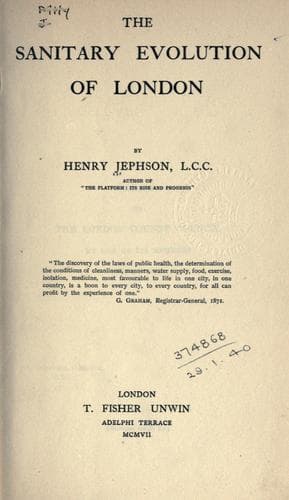
The Sanitary Evolution of LondonJephson, Henry (Henry Lorenzo)
History
The Sanitary Evolution of London
Jephson, Henry (Henry Lorenzo)
Public health -- England -- London
Even in the Strand District there were (1856)--
"Nuisances arising from various branches of industry, the slaughtering
of sheep and calves in the back-yards, and even in the cellars and
kitchens, and the keeping of cows in the basements under private
dwelling-houses, conditions which continue to exist in the most crowded
parts of this district, and should on no account be permitted in such
a district:" whilst in Westminster "pig-keeping existed to a very
considerable extent."
In some of the outer parishes the "foetid emanations" caused in the
process of brickmaking added to the general impurity of the air.
There were many other local causes of impurity of the atmosphere, some
even caused by the Sanitary Authorities themselves. Thus the more
thorough scavenging and removal of the filth of streets and houses,
vitally necessary as that was, resulted in the accumulation of great
heaps of filth in crowded centres.
Thus the Medical Officer of Health for Fulham reported that:--
"The collection of dust heaps, and dust contractors' depôts, constitute
a most injurious and offensive nuisance--enormous quantities of animal
and vegetable matter are heaped together, from which the most noxious
effluvia constantly arise."
And the Medical Officer of Health for Rotherhithe pointed out (1858)
that:--
"It is little use causing our own dust to be carted away if Rotherhithe
is to become the receptacle of all the ashes and offal of a large
neighbouring parish (Bermondsey). On a piece of land near the Viaduct
there stands an immense heap of house refuse, covering an acre of
ground at least, and forming quite an artificial hillock, the level
of the surface having been raised 12-14 feet. The bulk of the heap is
composed of ashes with a due admixture of putrefying vegetable matter
and fish."
A little later he reports it as 1-1/2 acres in extent, averaging 15
feet high, in one place as high as 20 feet.
How to deal with these noxious or offensive trades was felt by some of
the Medical Officers of Health to be a great difficulty.
"We have the health of the community on the one hand," wrote the
Medical Officer of Health for Lambeth; "the great manufacturing
interests on the other.... We have all a common right to an unpolluted
atmosphere, and it is our bounden duty to withstand any encroachments
on that right. The personal aggrandisement of the manufacturer must not
be achieved by the spoliation of the property, the comforts, and the
lives of his poorer neighbours....
"But the manufacturing interest is not a thing to be trifled with.
Destroy the manufactures of Lambeth, and you starve its population.
There are nuisances of more benefit than of injury to the community,"
and he rather deprecated "a crusade against those interests, the
untrammelled prosecution of which has raised this country to its
present proud pre-eminence."
Some of the Medical Officers of Health expressed decided views on the
subject (1857):--
Public-domain text, read in full here on John Shaqi.
Reviews
Reviews
No reviews yet
Be the first to share your thoughts on this work.
Elsewhere in the archive
Join the Discussion
Join the discussion
Sign in to leave a comment or review.
Sign InorCreate an account