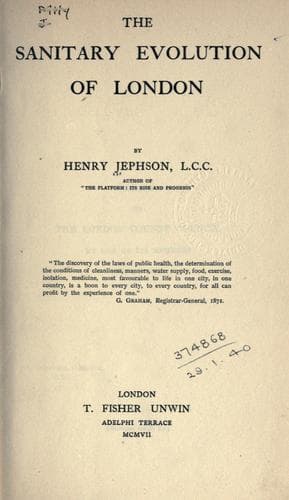
The Sanitary Evolution of LondonJephson, Henry (Henry Lorenzo)
History
The Sanitary Evolution of London
Jephson, Henry (Henry Lorenzo)
Public health -- England -- London
"Men whose nervous systems became depressed, and the tone of their
system generally lowered, became the subjects of a continued craving
for stimulants."[70]
Dr. Simon, Medical Officer of the General Board of Health, wrote:--
"In an atmosphere which forbids the breath to be drawn freely, which
maintains habitual ill-health and depresses all the natural spring
and buoyancy of life, who can wonder that frequent recourse is had to
stimulants?"
The evils were disastrous enough for the adult population, but they
fell with more dire effect upon infants and young children.
"Conditions more or less injurious to health gradually impair the
matured energies and slowly undermine the fully developed constitution
of the adult; but the self-same conditions, exerting their baneful
influence on the infant or young child, nip the tender plant in the bud
and speedily destroy its young life."[71]
Throughout the whole of the metropolis the infantile mortality--that
is, of children under five years of age--was very great: Almost without
exception it was close upon, or over, 50 per cent. of all the deaths in
the various parishes or districts.
In Clerkenwell the infantile mortality, which was "nearly one-half of
all the deaths," was characterised as "enormous"; but in Shoreditch it
was actually one-half, being 50 per cent. (1858); in Bethnal Green it
was over one-half, being 52 per cent. (1858); in St. George-in-the-East
it was 53-1/2 per cent.--or, to put it otherwise, of 1,351 deaths in
the year, 720 were of children under five. In Poplar it was more than
half. In Islington, in 1857, nearly half. In St. Saviour, Southwark, 50
per cent. in 1860-1, "a waste of life which appears almost incredible."
In Limehouse (in 1857) of 1,403 deaths 690 were under five.
The Medical Officer of Health wrote:--
"It is when such wretched offspring, ill-nourished, ill-clothed, and in
every way neglected, become exposed to the depressing influences of an
impure atmosphere that they sicken, and such children when they sicken
they die.... When the habitation of such children is an overcrowded,
dilapidated tenement in some close, ill-ventilated court or alley,
furnished with an undrained closet, surrounded by untrapped drains, and
festering heaps of filth, we find ourselves astonished, not that so
many die, but that so many survive."
In some special places the mortality was still higher. Thus the Medical
Officer of Health for Kensington reports in 1856:--
"In some places the mortality among infants under five years of age was
at the enormous rate of 61·3 per cent. of the total deaths.
"One of the most deplorable spots, not only in Kensington, but in the
whole metropolis, is the Potteries at Nottingdale. It occupies about
8 or 9 acres, and contains about 1,000 inhabitants ... the general
death-rate varies from 40-60 per 1,000 per annum. Of these deaths, the
very large proportion of 87·5 per cent. are under five years of age."
Public-domain text, read in full here on John Shaqi.
Reviews
Reviews
No reviews yet
Be the first to share your thoughts on this work.
Elsewhere in the archive
Join the Discussion
Join the discussion
Sign in to leave a comment or review.
Sign InorCreate an account