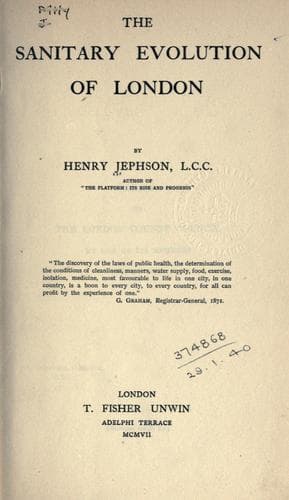
The Sanitary Evolution of LondonJephson, Henry (Henry Lorenzo)
History
The Sanitary Evolution of London
Jephson, Henry (Henry Lorenzo)
Public health -- England -- London
The result was a fearful mortality--an awful waste of human life.
"Death," wrote one of the Medical Officers of Health, "finds easy
victims in filthy habits, overcrowded rooms, impure air, and
insufficient and ineffective water supply."
The consequences were inevitable.
"Wherever there are crowded apartments, imperfect or no drainage,
offensive cesspools, dung-heaps resting against houses or close to
inhabited rooms--wherever ventilation is impeded by the narrowness of
courts and alleys, and wherever the inhabitants living under these
unfavourable circumstances lose their self-respect, pay no regard to
personal cleanliness, and consider a state of filth and offensiveness
as their natural lot--there we find zymotic diseases in full force and
frequency. Those attacked do not simply recover or die. I shall not be
exaggerating when I say that all recovering from these complaints are
permanently injured."[66]
It is impossible to apportion the respective shares which these various
causes of insanitation had in bringing about these dire results, but
overcrowding was undoubtedly one of the principal. As to its disastrous
effects the Medical Officers of Health were of one opinion. There was
no single exception to the strong-voiced insistence upon this fact.
"The main cause," wrote the Medical Officer of Health for the Strand
(1856), "to which we must attribute the high mortality is the close
packing and overcrowding which exists throughout the district....
Overcrowding and disease mutually act and react upon each other.
"There is one circumstance of general prevalence throughout the
district which, so to speak, almost paralyses these efforts of sanitary
improvement--overcrowding--the overcrowding of parts of it with courts
and alleys, the overcrowding of these courts and alleys with houses,
the overcrowding of these houses with human beings" (1859).
"The overcrowding of dwellings," wrote another,[67] "is one of the most
frequent sources of sickness and decay at all ages."
"Perhaps," wrote a third,[68] "there is no single influence to which a
human being is exposed more prejudicial to his health than overcrowding
in rooms the air of which cannot be perpetually and rapidly changed."
"No axiom," wrote another,[69] "can be more positive than the
connection of epidemic diseases with defects of drainage and
ventilation ... the overcrowded localities being especially scourged by
disease."
The consequences were not confined to epidemic disease; other fatal
diseases were begotten by it.
"All medical writers," wrote the Medical Officer of Health for St.
James' (1858), "are agreed that impure air from want of ventilation is
the most potent of all causes of consumption."
Not merely directly did overcrowding bring about fatal results.
Indirectly it also led thither. It was recognised as a cause of
intemperance and of the evils, moral as well as physical, which ensued
from intemperance.
Public-domain text, read in full here on John Shaqi.
Reviews
Reviews
No reviews yet
Be the first to share your thoughts on this work.
Elsewhere in the archive
Join the Discussion
Join the discussion
Sign in to leave a comment or review.
Sign InorCreate an account