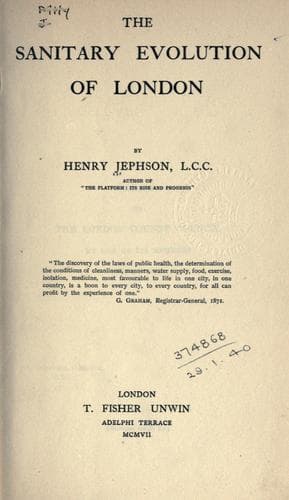
The Sanitary Evolution of LondonJephson, Henry (Henry Lorenzo)
History
The Sanitary Evolution of London
Jephson, Henry (Henry Lorenzo)
Public health -- England -- London
Others directed their attention to the promotion in a small way of
improvements in their parishes by widening streets and roads, and
preserving open spaces--towards which, in some cases, they received a
contribution from the central authority.
A good deal of paving was done, and better measures taken for
scavenging the streets and courts, and for the removal of refuse and
dirt of all sorts.
To local sewerage, as distinct from main sewerage, they also gave
attention, and in 1856 designs for 45 miles of new sewers were sent
in to the Metropolitan Board for approval, and £34,700 borrowed for
the purpose; and in the following year for 46 miles of new sewers, and
loans for £109,000.
A fair amount of drainage work was also carried out--thousands of
cesspools were filled in and drains made. Also a certain amount of
inspection, with the disclosure of an enormous amount of insanitation.
Thus, in the Strand District in 1856--where 813 houses were
inspected--in 774, or 91 per cent. of these, works had to be done
to remedy sanitary defects. In the following year 1,760 houses were
inspected, and in 1,102 sanitary defects were found. In Poplar, of
1,299 houses which were visited, 795 required sanitary improvement.
In Paddington 2,201 houses were inspected; in over 1,600 works had
to be executed to put them in sanitary order; figures which showed
that, roughly speaking, two out of every three houses were sanitarily
defective.
"The last year," wrote the Medical Officer of Health for Hackney
(1857)--where 1,518 houses had been connected with the sewers--"has
been a year of drainage."
Parliament having enacted that the "owner" was responsible for the
state of his property, this work had to be done at the expense of the
owners; but how many decades had passed in which "owners" had spent
nothing on the property, and had been receiving large rents; and how
many cases of sickness and death had occurred in their houses, the
result of the insanitary condition in which they had been allowed to
fall, and in which they were allowed to continue.
In Holborn such works cost the owners about £3,400 in 1857, and in
Lambeth about £10,700.
But the work thus chronicled touched little more than the fringe
of the matter. Most of the local authorities had, out of a spirit
of economy, or for some other reason, appointed only one Inspector
of Nuisances; yet in nearly every one of their parishes there were
thousands of houses--in Greenwich 11,000, in St. Marylebone 16,000, in
Lambeth 22,000--and years would have had to elapse before the solitary
inspector could have completed even one round of inspection and got the
houses he inspected put in order; whilst the others would inevitably
have been existing in, or falling into, a state of insanitation. For
years, therefore, the most vile disease-begetting nuisances might not
merely exist throughout the parish, but work endless evil without any
interference, as indeed they did.
Public-domain text, read in full here on John Shaqi.
Reviews
Reviews
No reviews yet
Be the first to share your thoughts on this work.
Elsewhere in the archive
Join the Discussion
Join the discussion
Sign in to leave a comment or review.
Sign InorCreate an account