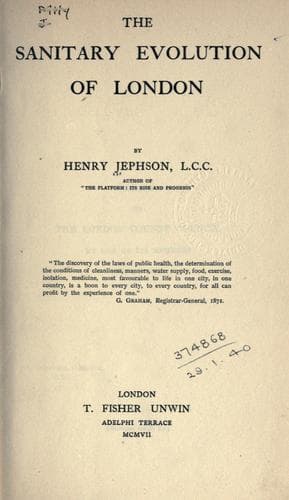
The Sanitary Evolution of LondonJephson, Henry (Henry Lorenzo)
History
The Sanitary Evolution of London
Jephson, Henry (Henry Lorenzo)
Public health -- England -- London
Some of the Vestries put forward their economy as a claim for praise.
Thus, the Wandsworth Board said that "a due and careful regard to
economy had characterised all their proceedings," and the Vestry of St.
Mary Newington said, in 1860, that it had carried out its operations
out of current income and had incurred no debt.
The Medical Officers of Health held their offices at the pleasure of
the Vestries, and, therefore, if they valued their position, had to be
cautious in their criticisms of the management of the affairs of the
parishes.
But their reports convey that the work which ought to have been done
was not being done as rapidly as they wished.
"I wish I could induce the Vestry to insist more upon having the poorer
dwellings cleansed and lime-whited." And again, "The Vestry has the
power to restrict the operation of underground rooms, yet it has not
moved in this important matter."[72]
The Medical Officer of Health for St. Giles' (1857) referred to the--
"Indisposition of the Board to do works and charge the owners"; and,
referring to a special case, he wrote, "It becomes your duty to do
something to prevent the production of disease among the neighbours."
The Medical Officer of Health for St. Pancras wrote in 1856-7:--
"In many houses the overcrowding is very great. There is a clause
under the Nuisances Removal Act by which the Vestry is called on to
take proceedings before a magistrate to abate overcrowding, if it is
certified to be such as to endanger health. No prosecutions have been
taken under this clause."
And again in 1859:--
"Very little has been done in this parish to abate
over-crowding--extreme cases have been proceeded against. No systematic
efforts have been made in this direction."
And the Medical Officer of Health for Hampstead wrote (1856):--
"Nothing short of constant vigilance and inspection can keep the
dwellings and premises of the people in a tolerably healthy state. I
am not sure that your Board is blameless in some of these respects--an
amiable, though weak, reluctance to act severely to any."
And in 1857 he pleaded for the appointment of an Inspector of
Nuisances, which, however, he did not get.
The local authorities had their difficulties in dealing with many of
these matters, even when they were disposed or anxious to do so, owing
to--
"The imperfection of the powers conferred on them by the legislature,
and to the great and stubborn apathy of a poor population."
And the Medical Officer of Health for St. James' (1858) attributed
blame to the public generally:--
Public-domain text, read in full here on John Shaqi.
Reviews
Reviews
No reviews yet
Be the first to share your thoughts on this work.
Elsewhere in the archive
Join the Discussion
Join the discussion
Sign in to leave a comment or review.
Sign InorCreate an account