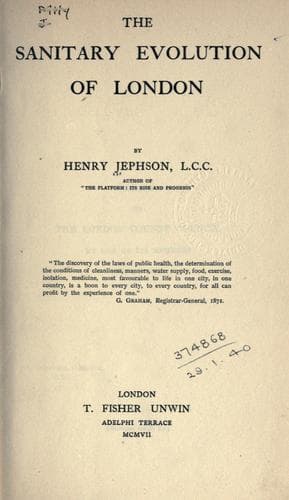
The Sanitary Evolution of LondonJephson, Henry (Henry Lorenzo)
History
The Sanitary Evolution of London
Jephson, Henry (Henry Lorenzo)
Public health -- England -- London
"Docks, railways, warehouses, &c., &c., must be constructed for the
increase of the trade of this great metropolis, but our construction
of them ought not to prevent us from providing better habitations for
the working classes whose labours effect these improvements; more
especially as it is in the power of parishes by virtue of an Act of
Parliament to encourage the establishment of lodging-houses for the
labouring classes."[73] Not one single Vestry or District Board ever
attempted to deal with the evils of bad housing and overcrowding by
putting into operation the provisions of this Act.
The occasional statement in the report of a Medical Officer of Health
as to what was actually done in his parish, by showing what might have
been done in any other one, brings into strong relief the incapacity or
deliberate inaction of the local authorities of other parishes. Thus,
in some parishes the Medical Officers of Health endeavoured to effect
some diminution of overcrowding--for instance, the Medical Officer of
Health for Islington reported that--
"In several instances the owners of dwelling-houses had been summoned
for permitting the overcrowding of their houses; and the magistrate had
fined the offenders."
And the Medical Officer of Health for Holborn in the same year wrote:--
"Your Board has already done much to ameliorate the condition of this
class of society (the poor and overcrowded) by compelling the owners
to cleanse, drain, and ventilate their dwellings; to close cellars, to
provide proper water supply, sanitary accommodation, and in many cases
had abated overcrowding."
But few of the Vestries followed, or attempted to follow, these
examples, and in many of the most vital matters a deliberate inactivity
was the prevailing characteristic of the Vestries and District Boards.
"In several Vestries resolutions were actually moved with the view of
averting the construction of sewers. It was thought by many persons of
influence to be better to live in the midst of overflowing cesspools
than to add to the defilement of the Thames."[74]
The Medical Officers of Health did not confine themselves to merely
reporting what was annually done to ameliorate the existing state of
affairs.
As was their duty, they made numerous and frequent suggestions to their
authorities as to what it was best to do. And some of them, going
further than this, sometimes endeavoured to inspire the members of the
Vestries and District Boards with a sense of the gravity of their work,
and with lofty views of their duty. Occasionally, even, they did not
hesitate to censure their employers for inaction or lethargy.
The Medical Officer of Health for the Strand wrote (1856):--
Public-domain text, read in full here on John Shaqi.
Reviews
Reviews
No reviews yet
Be the first to share your thoughts on this work.
Elsewhere in the archive
Join the Discussion
Join the discussion
Sign in to leave a comment or review.
Sign InorCreate an account