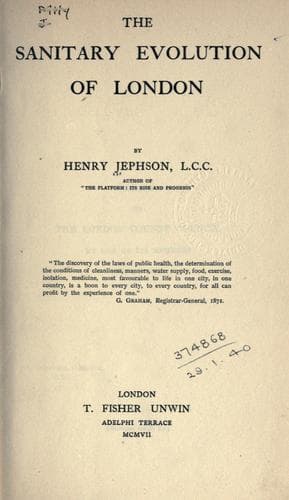
The Sanitary Evolution of LondonJephson, Henry (Henry Lorenzo)
History
The Sanitary Evolution of London
Jephson, Henry (Henry Lorenzo)
Public health -- England -- London
"One of the greatest barriers to the practical efficiency of sanitary
arrangements is the ignorance and carelessness of the public. It is
frequently seen that where infectious illness occurs, little or no
attention is paid to its infective character, and an unscrupulous
intercourse is carried on between the members of infected families, not
only amongst themselves, but amongst their neighbours, and thus these
diseases are propagated in spite of every warning and precaution."
"I regret," wrote the Medical Officer of Health for Whitechapel, "that
the powers of your Board are not at present sufficient to compel the
owners of small house property to provide an adequate supply of water
for their tenants."
The Medical Officer of Health for Westminster wrote:--
"Few of the objects of sanitary improvement can be fairly attained
without intrenching upon private interests to an extent which would
appear harsh and oppressive. One great obstacle consists in the habits
of a great portion of the poor--generally deficient in cleanliness or
order; they consider any endeavour to improve their dwelling as an
interference, and throw every obstacle in the way. On the other hand, a
large number are most grateful for what has been effected."
But in many matters the local authorities would not take action.
In only four parishes or districts in London had public baths and
wash-houses been established under the Act of 1846, though where they
were in existence "the benefits were immense by promoting habits of
cleanliness."
In Poplar in 1858-9 nearly 40,000 men, and 3,000 women, and 400
children availed themselves of the baths.
In St. Pancras (1856-7) the laundry department, erected by the "Society
for Establishing Public Baths and Wash-houses," was of great value in
affording the poor housewife an opportunity of washing and drying her
linen away from her one room, in which the family had to live night and
day.
"I have frequently seen a small room of this kind with from four to
eight or even ten inmates rendered doubly unhealthy by these laundry
operations, which produce a damp and almost malarious atmosphere."
The Medical Officer of Health for Lambeth had pleaded for such an
establishment in his district, but "the idea of erecting them seems
quite abandoned by the Vestry."
"I know nothing more objectionable in a sanitary point of view than
the washing of foul clothes in the dwellings of the poor, and still
worse the drying of them in courts and rooms already deficient of free
circulation of air and light."
Nothing, however, was done. But inaction far greater in gravity and
infinitely more reprehensible was that relating to the housing of the
people. The Medical Officer of Health for Whitechapel drew attention,
in his report of 1857, to their power in this respect:--
Public-domain text, read in full here on John Shaqi.
Reviews
Reviews
No reviews yet
Be the first to share your thoughts on this work.
Elsewhere in the archive
Join the Discussion
Join the discussion
Sign in to leave a comment or review.
Sign InorCreate an account