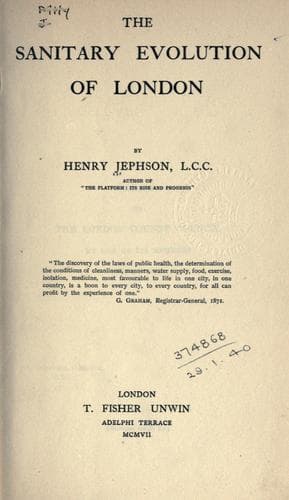
The Sanitary Evolution of LondonJephson, Henry (Henry Lorenzo)
History
The Sanitary Evolution of London
Jephson, Henry (Henry Lorenzo)
Public health -- England -- London
The Medical Officer of Health for St. Pancras made a calculation that
nearly 1,200 deaths in the parish in 1858 were due to causes which
might have been prevented by sanitary improvements. "To every death we
may safely assume more than thirty cases of illness. This gives us
36,000 cases of preventable disease in the year."
"You will see," wrote the Medical Officer of Health for St. James'
(1856), "that by diminishing death and disease, you are diminishing
poverty and want.... The sanitary question lies at the root of all
others. It is a national one and a religious one. It is true that in
the exercise of your powers you will often be met by the assertion of
the rights of property, but the right of life stands before the right
of property, and it is this recognition of the sacredness of human life
that lies at the foundation of sanitary legislation."
The Medical Officer of Health for Whitechapel wrote:--
"I have in this report, as in duty bound, spoken plainly; if in the
opinion of some members of the Board too plainly, my apology is--the
deep sense I entertain of the importance of sanitary progress; for upon
the success that shall attend the labours of those engaged in this
most sacred cause depends the improvement of the social, moral, and
intellectual condition of the people."
And the Medical Officer of Health for St. Giles' made this pathetic
appeal for action:--
"While you are listening to the remainder of this report, I trust you
will hold in your mind how many lives are being sacrificed every month
to deficiencies in sanitary arrangements."
It is only here and there in the earlier reports of the Medical
Officers of Health that specific mention is made of intemperance, but
every reference to the subject showed how largely "drink" affected
the sanitary condition of the people and intensified and complicated
the evil conditions in which the people were placed, and rendered any
amelioration, physical, moral, or religious, infinitely more difficult.
It was becoming more and more generally recognised that a very large
proportion of the deaths and of disease were preventable.
"Any skilled eye glancing over the mortality tables will observe that a
considerable number of deaths might have been prevented."
"We are now to a great extent aware," wrote the Medical Officer of
Health for St. Saviour's (1856), "of the physical conditions on which
the lives of individuals and communities depend."
The Medical Officer of Health for Fulham wrote in 1857:--
"Sanitary science and experience have full clearly proved to us how
great an extent the prevention of disease and its extension rests with
us."
But against contagion and infection no precautions whatever were taken,
and so disease was sown broadcast throughout the community, and death
followed.
As to suggested remedies and action there was a chorus of absolute
unanimity upon some points:--
Public-domain text, read in full here on John Shaqi.
Reviews
Reviews
No reviews yet
Be the first to share your thoughts on this work.
Elsewhere in the archive
Join the Discussion
Join the discussion
Sign in to leave a comment or review.
Sign InorCreate an account