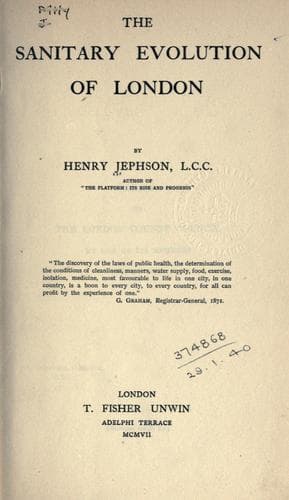
The Sanitary Evolution of LondonJephson, Henry (Henry Lorenzo)
History
The Sanitary Evolution of London
Jephson, Henry (Henry Lorenzo)
Public health -- England -- London
"The principal cause of the extent of zymotic disease," wrote the
Medical Officer of Health for Mile-End-Old-Town, in 1859, "is the
defective state of the habitations of the poorer classes. The remedy
for the evil is only to be secured by a systematic house visitation.
"... Without a general house inspection it is impossible to secure the
proper entry to and use of the expensive sewers which have been and are
being constructed.
"Having done so much for the streets, pavements, and drains, the
improvements will lose half their salutary effect if the interior of
the dwellings are not placed in a corresponding condition of wholesome
cleanliness."
"It is," wrote the Medical Officer of Health for Whitechapel, "to the
interior of the houses that our attention must be directed, for it is
here that the source of disease is usually found.... An habitual and
detailed inspection of the houses occupied by the poorer classes is
therefore essential."
A house-to-house visitation was, indeed, the first essential. By no
other means could the actual condition of the abodes of the people
be ascertained, and the breeding places of disease be discovered,
cleared out, and rendered innocuous. And as there was a never ceasing
tendency on the part of the poorer classes to sink into a condition
of uncleanliness, and on the part of their abodes to fall into
dilapidation, or, as it was expressed, "a pertinacity for dirt," so
was constant inspection and supervision of vital necessity for the
maintenance of any improvements made.
"There are," wrote the Medical Officer of Health for St. Pancras
(1858), "many parts of the parish densely crowded. Some of the
people have become so used to filth, they appear to prefer it to
cleanliness; at any rate, they have not the energy to get rid of it and
improve their condition. Such houses--perfect hotbeds of infectious
diseases--ought to be visited two or three times a year...."
The Medical Officers of Health had one valuable object lesson before
them in the common lodging-houses, which, regulated and inspected by
the police under the Acts passed by Parliament, had shown that even
the very worst conditions of life could be ameliorated, and that the
very lowest and most miserable classes of society were not beyond
improvement.
"The chief points which are regulated by the authorities (the Police)
are cleanliness, drainage and water supply, the separation of the
sexes, and the prevention of overcrowding. The testimony of all who
are acquainted with the dwellings of the poor is concurrent as to the
immense sanitary advantages gained by the provisions of the Common
Lodging Houses Act, and the results had been to improve in a marked
degree the health, habits, and morals of the persons using these
places."[75]
"The cleanliness, comfort, and ventilation of the licensed rooms in
common lodging-houses offer a very marked contrast to those which are
unlicensed."[76]
Public-domain text, read in full here on John Shaqi.
Reviews
Reviews
No reviews yet
Be the first to share your thoughts on this work.
Elsewhere in the archive
Join the Discussion
Join the discussion
Sign in to leave a comment or review.
Sign InorCreate an account