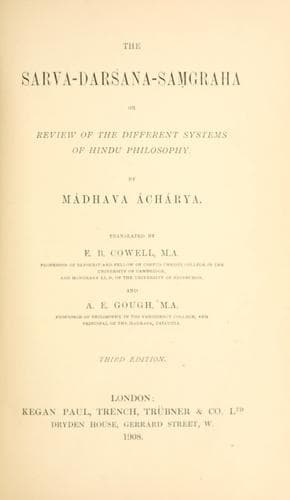
The Sarva-Darsana-Samgraha: Or, Review of the Different Systems of Hindu PhilosophyMadhava
ReligionEastern
The Sarva-Darsana-Samgraha: Or, Review of the Different Systems of Hindu Philosophy
Madhava
Philosophy, Hindu; Philosophy, Indic
"Action" is fivefold, according to the distinction of throwing
upwards, throwing downwards, contracting, expanding, and going:
revolution, evacuating, &c., being included under "going." The genus
of throwing upwards, &c., will be their respective definitions. The
genus of throwing upwards is a subordinate genus to action; it exists
with intimate relation, and is to be known as the mediate cause of
conjunction with a higher place. In the same manner are to be made the
definitions of throwing downwards, &c. Generality (or genus) is
twofold, extensive and non-extensive; existence is extensive as found
with intimate connection in substance and quality, or in quality and
action; substance, &c., are non-extensive. The definition of
generality has been given before. Particularity and intimate relation
cannot be divided,--in the former case in consequence of the infinite
number of separate particularities, in the latter from intimate
relation being but one; their definitions have been given before.
There is a popular proverb--
"Duality, change produced by baking, and disjunction produced by
disjunction,--he whose mind vacillates not in these three is the true
Vaiśeshika;" and therefore we will now show the manner of the
production of duality, &c.
There is here first the contact of the organ of sense with the object;
thence there arises the knowledge of the genus unity; then the
distinguishing perception _apekshábuddhi_ [by which we apprehend "this
is one," "this is one," &c.]; then the production of duality, _dvitva_
(in the object);[175] then the knowledge of the abstract genus of
duality (_dvitvatva_); then the knowledge of the quality duality as it
exists in the two things; then imagination[176] (_saṃskára_).[177]
But it may here be asked what is the proof of duality, &c., being thus
produced from _apekshábuddhi_? The great doctor (Udayana) maintained
that _apekshábuddhi_ must be the producer of duality, &c., because
duality is never found separated from it, while, at the same time, we
cannot hold _apekshábuddhi_ as the cause only of its being known [and
therefore it follows that it must be the cause of its being
produced[178]], just as contact is with regard to sound. We, however,
maintain the same opinion by a different argument; duality, &c.,
cannot be held to be made known (_jñápya_) by that non-eternal
apprehension whose object is two or more individual unities (_i.e._,
_apekshábuddhi_), because these are qualities which reside in a
plurality of subjects [and not in any one individual[179]] just as
"severalty" does [and, therefore, as _apekshábuddhi_ is not their
_jñápaka_, it must be their _janaka_].
Public-domain text, read in full here on John Shaqi.
Reviews
Reviews
No reviews yet
Be the first to share your thoughts on this work.
Elsewhere in the archive
Join the Discussion
Join the discussion
Sign in to leave a comment or review.
Sign InorCreate an account