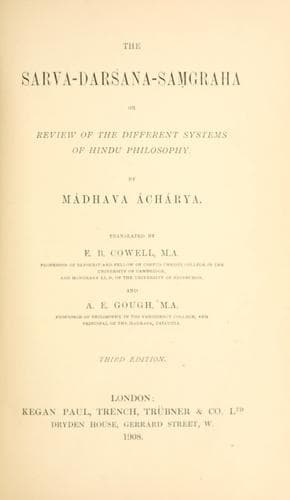
The Sarva-Darsana-Samgraha: Or, Review of the Different Systems of Hindu PhilosophyMadhava
ReligionEastern
The Sarva-Darsana-Samgraha: Or, Review of the Different Systems of Hindu Philosophy
Madhava
Philosophy, Hindu; Philosophy, Indic
It is a fixed rule that when the action of breaking arises in the
[material] cause which is inseparably connected with the effect
[_i.e._, in one of the two halves of the pot], and produces a
disjunction from the other half, there is not produced at that time a
disjunction from the place or point of space occupied by the pot; and,
again, when there is a disjunction from that point of space occupied
by the pot, the disjunction from the other half is not contemporary
with it, but has already taken place. For just as we never see smoke
without its cause, fire, so we never see that effect of the breaking
in the pot which we call the disjunction from the point of space,[187]
without there having previously been the origination of that
disjunction of the halves which stops the conjunction whereby the pot
was brought into being. Therefore the action of breaking in the parts
produces the disjunction of one part from another, but not the
disjunction from the point of space; next, this disjunction of one
part from another produces the destruction of that conjunction which
had brought the pot into existence; and thence arises the destruction
of the pot, according to the principle, _cessante causâ cessat
effectus_. The pot being thus destroyed, that disjunction, which
resides in both the halves (which are the material or intimate causes
of the pot) during the time that is marked by the destruction of the
pot or perhaps having reference only to one independent half,
initiates, in the case of that half where the breaking began, a
disjunction from the point of space which had been connected with the
pot; but not in the case of the other half, as there is no cause to
produce it.[188]
But the second kind is as follows:--As action which arises in the
hand, and causes a disjunction from that with which it was in contact,
initiates a disjunction[189] from the points of space in which the
original conjunction took place; and this is "the disjunction of the
intimate cause and the non-cause." When the action in the hand
produces an effect in relation to any points of space, it initiates
also in the same direction a disjunction of the intimate effect and
the non-effect; thus the disjunction of the body [the intimate effect]
and the points of space arises from the disjunction of the hand and
the points of space [the hand being an intimate or material cause of
the body, but the points of space being not a cause]. This second
disjunction is not produced by the action of the body, because the
body is supposed to be at the time inactive; nor is it produced by the
action of the hand, because it is impossible that an action residing
in some other place [as the hand] should produce the effect of
disjunction [in the body]. Therefore we conclude by exhaustion that we
must accept the view--that it is the disjunction of the intimate cause
and the non-cause[190] which causes the second disjunction of the
body and the points of space.
Public-domain text, read in full here on John Shaqi.
Reviews
Reviews
No reviews yet
Be the first to share your thoughts on this work.
Elsewhere in the archive
Join the Discussion
Join the discussion
Sign in to leave a comment or review.
Sign InorCreate an account