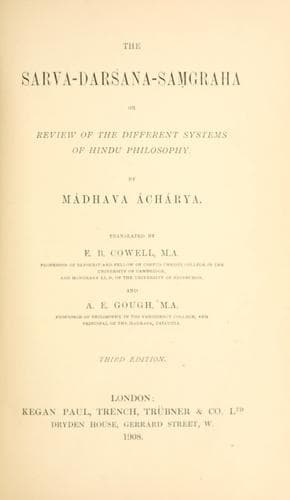
The Sarva-Darsana-Samgraha: Or, Review of the Different Systems of Hindu PhilosophyMadhava
ReligionEastern
The Sarva-Darsana-Samgraha: Or, Review of the Different Systems of Hindu Philosophy
Madhava
Philosophy, Hindu; Philosophy, Indic
But an opponent may here object that "what you formerly stated (p.
147) as to existence being denied of darkness, &c., is surely
unreasonable; for, in fact, there are no less than four different
opinions maintained on this point,--thus (_a._) the Bháṭṭa Mímáṃsakas
and the Vedántins hold that darkness is a substance; (_b._) Śrídhara
Áchárya[191] holds that the colour of dark blue is imposed [and thus
darkness will be a quality]; (_c._) some of the Prábhákara Mímáṃsakas
hold that it is the absence of the cognition of light; (_d._) the
Naiyáyikas, &c., hold that it is the absence of light." In reply, we
assert that as for the first alleged opinion (_a._) it is quite out of
the question, as it is consistent with neither of the two possible
alternatives; for if darkness is a substance, it must either be one of
the nine well-known substances, earth, &c.,[192] or some different
one. But it cannot be any one of the nine, since, under whichever one
you would place it, all the qualities of that substance should
certainly be found in it; nor can you, on the other hand, assert that
it is some substance different from these nine, since, being in itself
destitute of qualities, it cannot properly be a substance at all [the
very definition of substance being "that which is the substratum of
qualities"], and therefore, of course, it cannot be a different
substance from the nine. But you may ask, "How can you say that
darkness is destitute of qualities, when it is perceived as possessed
of the dark blue of the tamála blossom?" We reply, that this is merely
an error, as when men say that the [colourless] sky is blue. But
enough of this onslaught on ancient sages.[193] (_b._) Hence it
follows that darkness cannot have its colour imposed upon it, since
you cannot have an imposition of colour without supposing some
substratum to receive it;[194] and again, we cannot conceive the eye
as capable of imposing a colour when deprived of the concurrent cause,
the external light. Nor can we accept that it is an impression
independent of the eye [_i.e._, produced by the internal sense, mind],
because the concurrence of the eye is not a superfluous but an
indispensable condition to its being produced. Nor can you maintain
that "absence or non-existence (_abháva_[195]) is incapable of being
expressed by affirmative tense affixes [and, therefore, as we _do_ use
such phrases as _tenebræ oriuntur_, darkness cannot be a mere
non-existence"]; because your assertion is too broad, as it would
include such cases of non-existence as a mundane collapse,
destruction, inattention,[196] &c. [and yet we all know that men do
speak of any of these things as past, present, or future, and yet all
are cases of _abháva_]. (_c._) Hence darkness cannot be the absence of
the cognition of light, since, by the well-known rule that that organ
which perceives a certain object can also perceive its absence, it
would follow that darkness would be perceived by the mind [since it is
Public-domain text, read in full here on John Shaqi.
Reviews
Reviews
No reviews yet
Be the first to share your thoughts on this work.
Elsewhere in the archive
Join the Discussion
Join the discussion
Sign in to leave a comment or review.
Sign InorCreate an account