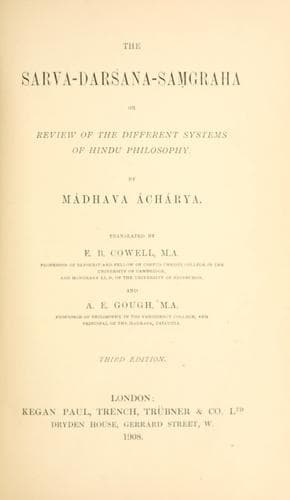
The Sarva-Darsana-Samgraha: Or, Review of the Different Systems of Hindu PhilosophyMadhava
ReligionEastern
The Sarva-Darsana-Samgraha: Or, Review of the Different Systems of Hindu Philosophy
Madhava
Philosophy, Hindu; Philosophy, Indic
Again, the Sánkhya opinion, which first lays down that nature and soul
are utterly distinct, and then holds that "liberation is the soul's
remaining as it is in itself after nature [on being known] has
withdrawn,"--even this opinion accepts our tenet of the abolition of
pain; but there is left a difficulty as to whether this cognition of
the distinction between nature and soul resides in the soul or in
nature. It is not consistent to say that it resides in the soul, since
the soul is held to be unchangeable, and this would seem to involve
that previously it had been hampered by ignorance; nor can we say that
it resides in nature, since nature is always held to be unintelligent.
Moreover, is nature spontaneously active or inactive? If the former,
then it follows that there can be no liberation at all, since the
spontaneous actions of things cannot be set aside; and if the latter,
the course of mundane existence would at once cease to go on.
Again, we have the same recognition of our "abolition of pain" in the
doctrine of Bhaṭṭa Sarvajña and his followers, that "Liberation is the
manifestation of an eternal happiness incapable of being increased;"
but here we have the difficulty that an eternal happiness does not
come within the range of definite proof. If you allege Śruti as the
proof, we reply that Śruti has no place when the thing itself is
precluded by a valid non-perception;[229] or if you allow its
authority, then you will have to concede the existence of such things
as floating stones.[230]
Public-domain text, read in full here on John Shaqi.
Reviews
Reviews
No reviews yet
Be the first to share your thoughts on this work.
Elsewhere in the archive
Join the Discussion
Join the discussion
Sign in to leave a comment or review.
Sign InorCreate an account