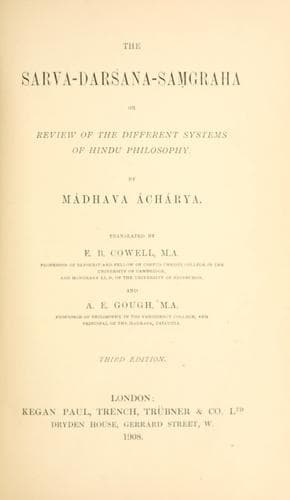
The Sarva-Darsana-Samgraha: Or, Review of the Different Systems of Hindu PhilosophyMadhava
ReligionEastern
The Sarva-Darsana-Samgraha: Or, Review of the Different Systems of Hindu Philosophy
Madhava
Philosophy, Hindu; Philosophy, Indic
And for the latter, since the continued series of cognitions when
accompanied by the natural obstacles[224] is said to be "bound," and
when freed from those obstacles is said to be "liberated," you cannot
establish an identity of the subject in the two states so as to be
able to say that the very same being which _was_ bound _is_ now
liberated.
Nor do we find the path of the Jainas, viz., that "Liberation is the
releasing from all 'obstructions,'" a path entirely free from bars to
impede the wayfarer. Pray, will our Jaina friend kindly inform us what
he means by "obstruction"?[225] If he answers "merit, demerit, and
error," we readily grant what he says. But if he maintains that "the
body is the true obstruction, and hence Liberation is the continual
upspringing of the soul consequent on the body's annihilation, as of
a parrot released from its cage," then we must inquire whether this
said soul possesses form or not. If it possesses form, then has it
parts or not? If it has no parts, then, since the well-known
definition of an atom will apply here as "that which has form without
parts," it will follow that the attributes of the soul are, like those
of an atom, imperceptible to the senses.[226] If you say that it has
parts, then the general maxim that "whatever has parts is
non-eternal," would necessitate that the soul is non-eternal; and if
this were conceded, then two grand difficulties [against the
Providential course of the world] would burst in unopposed, viz., that
what the soul has done would, at its cessation, perish with it [and
thus fail of producing the proper fruit], while it would have reaped
during life the effects of what it had not done [as the good and evil
which happened to it would not be the consequences of its actions in a
former birth]. If, on the other hand, the Jaina maintains that the
soul does not possess form at all, then how can he talk of the soul's
"upspringing," since all such actions as motion necessarily involve an
agent possessing form?[227]
Again, if we take the Chárváka's view "that the only bondage is
dependence on another, and therefore independence is the true
liberation,"--if by "independence" he means the cessation of pain, we
have no need to controvert it. But if he means autocratic power, then
no sensible man can concede it, as the very idea of earthly power
involves the idea of a capability of being increased and of being
equalled.[228]
Public-domain text, read in full here on John Shaqi.
Reviews
Reviews
No reviews yet
Be the first to share your thoughts on this work.
Elsewhere in the archive
Join the Discussion
Join the discussion
Sign in to leave a comment or review.
Sign InorCreate an account