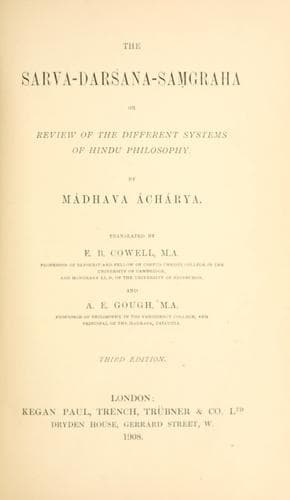
The Sarva-Darsana-Samgraha: Or, Review of the Different Systems of Hindu PhilosophyMadhava
ReligionEastern
The Sarva-Darsana-Samgraha: Or, Review of the Different Systems of Hindu Philosophy
Madhava
Philosophy, Hindu; Philosophy, Indic
But it may be objected, "Is there any proof at all for the existence
of a Supreme Being, _i.e._, perception, inference, or Śruti? Certainly
perception cannot apply here, since the Deity, as devoid of form, &c.,
must be beyond the senses. Nor can inference hold, since there is no
universal proposition or true middle term which can apply.[232] Nor
can Śruti, since neither of the resulting alternatives can be
sustained; for is it supposed to reveal, as being itself eternal, or
as non-eternal? Under the former view an established tenet of our
school would be contradicted [viz., that the Veda is non-eternal];
under the latter, we should be only arguing in a circle.[233] As for
comparison and any other proof which might be adduced [as that
sometimes called presumption, &c.], they need not be thought of for a
moment, as their object matter is definitely limited, and cannot apply
to the present case.[234] Therefore the Supreme Being seems to be as
unreal as a hare's horn." But all this elaborate disputation need
excite no flurry in the breast of the intelligent, as it can be at
once met by the old argument, "The mountain, seas, &c., must have had
a maker from their possessing the nature of effects just like a jar."
(_a._) Nor can our middle term [possessing the nature of effects] be
rejected as unproved (_asiddha_), since it can be established beyond a
doubt by the fact of the subject's possessing parts. "But what are we
to understand by this 'possessing parts'? Is it 'existing in contact
with parts,' or 'in intimate relation with parts'? It cannot be the
first, since this would equally apply to such eternal things as
ether,[235] &c.; nor can it be the second, since this would prove too
much, as applying to such cases as the [eternal] species, thread,
which abides in intimate relation with the individual threads. It
therefore fails as a middle term for your argument." We reply, that it
holds if we explain the "possessing parts" as "belonging to the class
of those substances which exist in intimate relation."[236] Or we may
adopt another view and maintain that it is easy to infer the
"possessing the nature of effects" from the consideration of their
possessing intermediate magnitude.[237]
(_b._) Nor can our middle term be rejected as "contradictory"
(_viruddha_),[238] since there is no such acknowledged universal
proposition connected with it as would establish the opposite major term
to that in our syllogism [_i.e._, that they must have had no maker].
(_c._) Nor is our middle term too general (_anaikánta_), since it is never
found in opposite instances [such as the lake, which is the _vipaksha_ in
the argument, "The mountain has fire because it has smoke"]. (_d._) Nor
again is it precluded (_bádhita_ or _kálátyayopadishṭa_), for there is no
superior evidence to exercise such a precluding power. (_e._) Nor is it
counter-balanced (_sat-pratipakshita_), for there does not appear to be
any such equally valid antagonist.
Public-domain text, read in full here on John Shaqi.
Reviews
Reviews
No reviews yet
Be the first to share your thoughts on this work.
Elsewhere in the archive
Join the Discussion
Join the discussion
Sign in to leave a comment or review.
Sign InorCreate an account