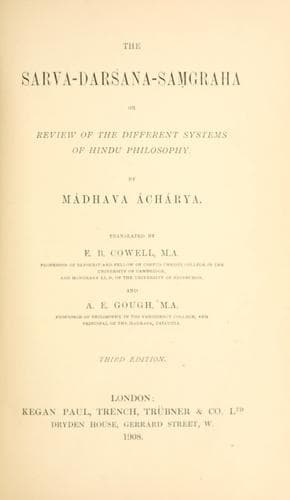
The Sarva-Darsana-Samgraha: Or, Review of the Different Systems of Hindu PhilosophyMadhava
ReligionEastern
The Sarva-Darsana-Samgraha: Or, Review of the Different Systems of Hindu Philosophy
Madhava
Philosophy, Hindu; Philosophy, Indic
If you bring forward as an antagonistic syllogism, "The mountains,
&c., cannot have had a maker, from the fact that they were not
produced by a body, just as is the case with the eternal ether,"--this
pretended inference will no more stand examination than the young fawn
can stand the attack of the full-grown lion; for the additional words
"by a body" are useless, since "from the fact that they were not
produced" would be a sufficient middle term by itself [and the
argument thus involves the fallacy called _vyápyatvásiddhi_].[239] Nor
can you retort, "Well, let this then be our middle term;" for you
cannot establish it as a real fact. Nor again is it possible to raise
the smallest shadow of a fear lest our middle term should be liable
to limitation by any suggested condition (_upádhi_),[240] [such as
"the being produced by a corporeal agent," to limit our old reason
"from having the nature of effects"], because we have on our side a
valid line of argument to establish our view, viz., "If the mountains,
&c., had no maker, then they would not be effects" [but all do
acknowledge that they have the nature of effects], for in this world
that is not an effect which can attain its proper nature independently
of any series of concurrent causes. And this series inevitably
involves the idea of some sort of maker; and I mean by "being a maker"
the being possessed of that combination of volition, desire to act,
and knowledge of the proper means, which sets in motion all other
causes, but is itself set in motion by none. And hence we hold that if
the necessity of a maker were overthrown, the necessity of the action
of all the other causes would be simultaneously overthrown, since
these are dependent thereon; and this would lead to the monstrous
doctrine that effects could be produced without any cause at all.
There is a rule laid down by Śaṅkara-kiṅkara which applies directly to
the present case--
"When a middle term is accompanied by a sound argument to
establish its validity,
"Then you cannot attempt to supply a limiting condition on
account of the [supposed] non-invariable concomitance of the
major term."
If you maintain that there are many sound counter-arguments, such as
"If the Supreme Being were a maker, He would be possessed of a body,"
&c., we reply, that all such reasoning is equally inconsistent,
whether we allow that Supreme Being's existence to be established or
not.[241]
As has been said by Udayana Áchárya [in the Kusumáñjali, iii. 5]--
"If Śruti, &c., have any authority, your negative argument
fails from being precluded; if they are fallacious, our old
objection of a 'baseless inference' returns stronger than
ever."
Nor need we fear the possibility of any other contradiction to our
argument, since it would be overthrown by either alternative of God's
being known or unknown.[242]
Public-domain text, read in full here on John Shaqi.
Reviews
Reviews
No reviews yet
Be the first to share your thoughts on this work.
Elsewhere in the archive
Join the Discussion
Join the discussion
Sign in to leave a comment or review.
Sign InorCreate an account