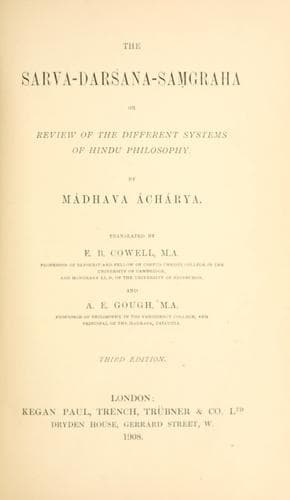
The Sarva-Darsana-Samgraha: Or, Review of the Different Systems of Hindu PhilosophyMadhava
ReligionEastern
The Sarva-Darsana-Samgraha: Or, Review of the Different Systems of Hindu Philosophy
Madhava
Philosophy, Hindu; Philosophy, Indic
[Footnote 297: The Nyáya holds that wrong knowledge is produced by a
"defect," as jaundice, &c., in the eye, and right knowledge by a
_guṇa_ or "virtue" (as the direct contact of the healthy organ with a
true object), or by the absence of a "defect."]
[Footnote 298: The _guṇa_ (or βελτἱστη ἕξις) of an organ is not
properly a cause of _pramá_ but rather _doshábháva-bodhaka_.]
[Footnote 299: _Scil._ "doubtful" (_sandigdha_) and "ascertained
non-authoritativeness" (_niśchitáprámáṇya_).]
[Footnote 300: _Utsarga_ is a general conclusion which is not
necessarily true in every particular case; but here it means the
conclusion that "right knowledge has no special causes but the common
causes of knowledge, the eye," &c.]
[Footnote 301: The first knowledge is "This is a jar," the second
knowledge is the cognition of this perception in the form "I perceive
the jar;" and simultaneously with it arises the cognition of the truth
of the perception, _i.e._, its authoritativeness or _prámáṇya_.]
[Footnote 302: This seems to be a quotation of Udayana's own words,
and no doubt is taken from his very rare prose commentary on the
Kusumáñjali, a specimen of which I printed in the preface to my
edition. This passage must come from the fifth book (v. 6?).]
[Footnote 303: I read _tat-práchuryam_ for _tatpráchurye_ in p. 134,
line 7.]
[Footnote 304: This stanza affirms that according to the Mímáṃsá
school, while authoritativeness is self-proved, non-authoritativeness
is proved from something else (as inference, &c.)]
[Footnote 305: I take _vyutpatti_ here as used for _śakti_; _siddhe_
means _ghaṭádau_.]
[Footnote 306: These are the two great Mímáṃsá schools. The former, called
_abhihitánvaya-vádinaḥ_, hold (like the Naiyáyika school) that words by
themselves can express their separate meaning by the function _abhidhá_ or
"denotation;" these are subsequently combined into a sentence expressing
one connected idea. The latter, called _anvitábhidhána-vádinaḥ_, hold that
words only express a meaning as parts of a sentence and grammatically
connected with each other; they only mean an action or something connected
with an action. In _gám ánaya_, _gám_ does not properly mean _gotva_, but
_ánayanánvita-gotva_, _i.e._, the bovine genus as connected with
"bringing." We cannot have a case of a noun without some governing verb,
and _vice versâ_. Cf. Waitz, as quoted by Professor Sayce (_Comparative
Philology_, page 136): "We do not think in words but in sentences; hence
we may assert that a living language consists of sentences, not of words.
But a sentence is formed not of single independent words, but of words
which refer to one another in a particular manner, like the corresponding
thought, which does not consist of single independent ideas, but of such
as, connected, form a whole, and determine one another mutually."]
CHAPTER XIII.
THE PÁṆINI-DARŚANA.[307]
Public-domain text, read in full here on John Shaqi.
Reviews
Reviews
No reviews yet
Be the first to share your thoughts on this work.
Elsewhere in the archive
Join the Discussion
Join the discussion
Sign in to leave a comment or review.
Sign InorCreate an account