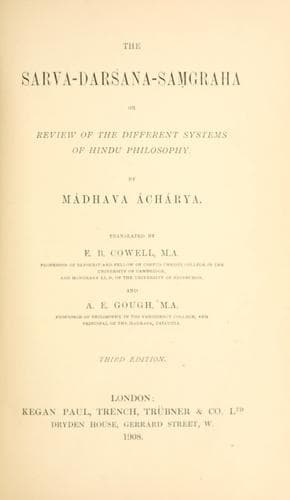
The Sarva-Darsana-Samgraha: Or, Review of the Different Systems of Hindu PhilosophyMadhava
ReligionEastern
The Sarva-Darsana-Samgraha: Or, Review of the Different Systems of Hindu Philosophy
Madhava
Philosophy, Hindu; Philosophy, Indic
[Footnote 284: This is Prabhákara's view (see Siddh. Muktáv., p. 118).
The first knowledge is in the form "This is a jar;" the second
knowledge is the cognition of this perception in the form "I perceive
the jar;" and this latter produces authoritativeness (_prámáṇya_),
which resides in it as its characteristic.]
[Footnote 285: Substances are "intimate causes" to their qualities,
and only substances have qualities; now if authoritativeness, which is
a characteristic of right knowledge, were caused by it, it would be a
quality of it, that is, right knowledge would be its intimate cause
and therefore a substance.]
[Footnote 286: The eye, &c., would be its instrumental causes.]
[Footnote 287: The first three categories "substance," "quality," and
"action," are called _játis_ or species; the last four, "genus,"
"_viśesha_," "intimate relation," and "non-existence," are called
_upádhis_ or "general characteristics."]
[Footnote 288: The Púrva Mímáṃsá denies that recollection is right
knowledge.]
[Footnote 289: Wrong knowledge is produced by the same instrumental
causes (as the eye, &c.) which produced right knowledge, but by these
_together with a "defect,"_ as biliousness, distance &c.]
[Footnote 290: _Scil._ if there be _doshábháva_ there is _pramá_; if
not, not. In p. 132, line 20, I read _doshábhávatvena_ for
_doshábhávasahakṛitatvena_.]
[Footnote 291: _Anyathásiddhatvam_ means _niyatapúrvavartitve sati
anávaśyakatvam_.]
[Footnote 292: _Scil._ or the absence of "defect," _doshábháva_.]
[Footnote 293: Wrong knowledge has _doshábháva_ or the presence of a
"defect" as its cause, in addition to the common causes.]
[Footnote 294: Wrongness of knowledge (_apramátva_) can only reside in
knowledge as a characteristic or quality thereof; it cannot reside in
a jar. The jar is, of course, produced by other instrumental causes
than those of knowledge (as, _e.g._, the potter's stick, &c.), but it
is not produced by these other causes _in combination_ with being also
produced by the instrumental causes of knowledge (with which it has
nothing directly to do); and so by a quibble, which is less obvious in
Sanskrit than in English, this wretched sophism is allowed to pass
muster. The jar is not
produced-by-any-other-instrumental-causes-than-those-of-knowledge,-while-
at-the-same-time-it-is-produced-by-these.]
[Footnote 295: I suppose this is the argument given at the close of
the previous long púrva-paksha.]
[Footnote 296: These words "and is other than defect"
(_dosha-vyatirikta_) are, of course, meaningless as far as right
knowledge is concerned; they are simply added to enable the author to
bring in "wrong knowledge" as an example. Wrong knowledge is caused by
the causes of knowledge _plus_ "defect;" right knowledge by the former
alone.]
Public-domain text, read in full here on John Shaqi.
Reviews
Reviews
No reviews yet
Be the first to share your thoughts on this work.
Elsewhere in the archive
Join the Discussion
Join the discussion
Sign in to leave a comment or review.
Sign InorCreate an account