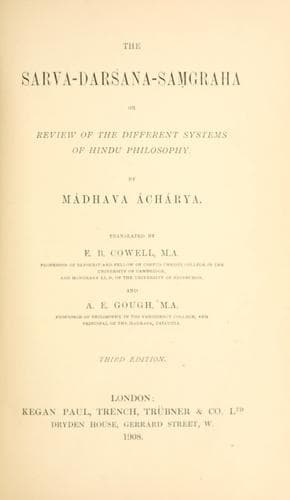
The Sarva-Darsana-Samgraha: Or, Review of the Different Systems of Hindu PhilosophyMadhava
ReligionEastern
The Sarva-Darsana-Samgraha: Or, Review of the Different Systems of Hindu Philosophy
Madhava
Philosophy, Hindu; Philosophy, Indic
Here, however, arises a discussion [as to the true application of the
alleged rule of Páṇini], for we hold that, by ii. 3, 66, wherever an
object and an agent are both expressed in one and the same sentence in
connection with a word ending with a _kṛit_ affix, there the object
alone can be put in the genitive and not the agent;[309] this
limitation arising from our taking _ubhayaprápti_ in the sútra as a
_bahuvríhi_ compound.[310] Thus we must say, "Wonderful is the milking
of cows by an unpractised cowherd." We may, however, remark in passing
that some authors do maintain that the agent may in such cases be put
in the genitive (as well as the object); hence we find it stated in
the Káśiká Commentary: "Some authors maintain that there should be an
option in such cases without any distinction, and thus they would
equally allow such a construction as 'the exposition of words _of_ the
teacher' or '_by_ the teacher.'" Inasmuch, however, as the words of
the phrase in question really mean that the "exposition" intended
relates to _words_ and not to _things_, and since this can be at once
understood without any mention of the agent, _i.e._, the teacher, any
such mention would be plainly superfluous; and therefore as the object
and the agent are _not_ both expressed in one and the same sentence,
this is not an instance of the genitive of the object (coming under
ii. 3, 66, and ii. 2, 14), but rather an instance of quite another
rule, viz., ii. 3, 65, which directs that an agent or an object, in
connection with a word ending with a kṛit affix, is to be put in the
genitive [which in this instance is expressed by the _tatpurusha_
compound]; and the compound in question will be strictly analogous to
such recognised forms as _idhma-pravraśchana_, _paláśa-śátana_,
&c.[311] Or we might argue that the genitive case implied in this
_shashṭhítatpurusha_ is one of the class called "residual," in
accordance with Páṇini's rule (ii. 3, 50), "Let the genitive be used
in the residuum," [_i.e._, in the other constructions not provided for
by special rules];[312] and in this way we might defend the phrase
against the opponent's attack. "But," it might be replied, "your
alleged 'residual genitive' could be assumed everywhere, and we should
thus find all the prohibitions of composition in constructions with a
genitive case rendered utterly nugatory." This we readily grant, and
hence Bhartṛihari in his _Vákyapadíya_ has shown that these rules are
mainly useful where the question relates to the _accent_.[313] To this
effect are the words of the great doctor Vardhamána--
"In secular utterances men may proceed as they will,
"But in Vaidic paths let minute accuracy of speech be
employed.
"Thus have they explained the meaning of Páṇini's sútras,
since
"He himself uses such phrases as _janikartuḥ_ and
_tatprayojakaḥ_."[314]
Public-domain text, read in full here on John Shaqi.
Reviews
Reviews
No reviews yet
Be the first to share your thoughts on this work.
Elsewhere in the archive
Join the Discussion
Join the discussion
Sign in to leave a comment or review.
Sign InorCreate an account