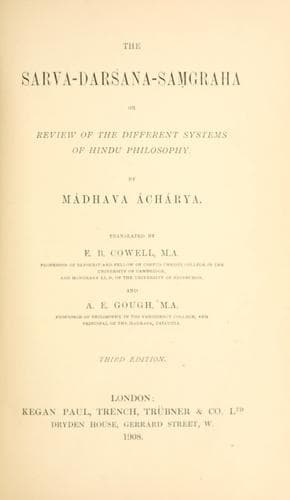
The Sarva-Darsana-Samgraha: Or, Review of the Different Systems of Hindu PhilosophyMadhava
ReligionEastern
The Sarva-Darsana-Samgraha: Or, Review of the Different Systems of Hindu Philosophy
Madhava
Philosophy, Hindu; Philosophy, Indic
Hence it follows that the full meaning of the sentence in question
(of the _Mahábháshya_) is that "it is to be understood that the rules
of grammar which may be taken as a synonym for 'the exposition
concerning words' are now commenced."
"Well, then, for the sake of directly understanding this intended
meaning, it would have been better to have said 'now comes grammar,'
as the words 'now comes the exposition of words' involve a useless
excess of letters." This objection cannot, however, be allowed, since
the employment of such a word as _śabdánuśásanam_, the sense of which
can be so readily inferred from its etymology, proves that the author
intends to imply an end which shall establish that grammar is a
subordinate study (_aṅga_) to the Veda.[315] Otherwise, if there were
no such end set forth, there would be no consequent application of the
readers to the study of grammar. Nor may you say that this application
will be sufficiently enforced by the injunction for study, "the Veda
with its six subordinate parts must be read as a duty without any
(special) end,"[316] because, even though there be such an injunction,
it will not follow that students will apply to this study, if no end
is mentioned which will establish that it is an _aṅga_ of the Veda.
Thus in old times the students, after reading the Veda, used to be in
haste to say--
"Are not Vaidic words established by the Veda and secular by
common life,
"And therefore grammar is useless?"
Therefore it was only when they understood it to be an _aṅga_ of the
Veda that they applied themselves to its study. So in the same way the
students of the present day would not be likely to apply themselves to
it either. It is to obviate this danger that it becomes necessary to
set forth some end which shall, at the same time, establish that
grammar is an _aṅga_ of the Veda. If, when the end is explained, they
should still not apply themselves, then, being destitute of all
knowledge of the true formation of secular words, they would become
involved in sin in the course of sacrificial acts, and would
consequently lose their religious merit. Hence the followers of
sacrifice read, "One who keeps up a sacrificial fire, on using an
incorrect word, should offer an expiatory offering to Saraswatí." Now
it is to declare this end which establishes that it is an _aṅga_ of
the Veda that he uses the words _atha śabdánuśásanam_ and not _atha
vyákaraṇam_. Now the rules of grammar must have an end, and a thing's
end is determined by men's pursuit of it with a view thereto. Just as
in a sacrifice undertaken with a view to heaven, heaven is the end; in
the same way the end of the exposition of words is instruction
concerning words, _i.e._, propriety of speech. "But," an objector may
say, "will not the desired end be still unattained for want of the
true means to it? Nor can it be said that reading the Veda word by
word is the true means; for this cannot be a means for the
Public-domain text, read in full here on John Shaqi.
Reviews
Reviews
No reviews yet
Be the first to share your thoughts on this work.
Elsewhere in the archive
Join the Discussion
Join the discussion
Sign in to leave a comment or review.
Sign InorCreate an account