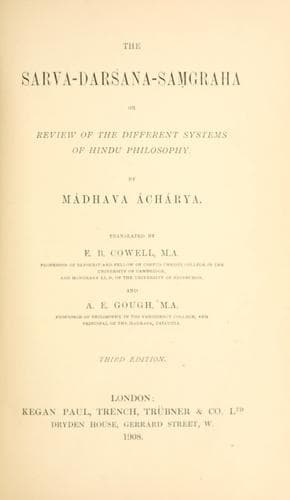
The Sarva-Darsana-Samgraha: Or, Review of the Different Systems of Hindu PhilosophyMadhava
ReligionEastern
The Sarva-Darsana-Samgraha: Or, Review of the Different Systems of Hindu Philosophy
Madhava
Philosophy, Hindu; Philosophy, Indic
According to the opinion of Vájapyáyana, who maintains that all words
mean a genus, words like "cow," &c.,[339] denote a genus which resides
by intimate relation in different substances; and when this genus is
apprehended, through its connection with it we apprehend the
particular substance in which it resides. Words like "white," &c.,
denote a genus which similarly resides in qualities; through the
connection with genus we apprehend the quality, and through the
connection with the quality we apprehend the individual substance. So
in the case of words expressing particular names, in consequence of
the recognition that "this is the same person from his first coming
into existence to his final destruction, in spite of the difference
produced by the various states of childhood, youth, adolescence, &c.,"
we must accept a fixed genus as Devadatta-hood,[340] &c. [as directly
denoted by them]. So, too, in words expressing "action" a genus is
denoted; this is the root-meaning, as in _paṭhati_, "he reads," &c.,
since we find here a meaning common to all who read.
In the doctrine of Vyáḍi, who maintained that words meant individual
things [and not classes or genera], the individual thing is put
forward as that which is primarily denoted, while the genus is implied
[as a characteristic mark]; and he thus avoids the alleged faults of
"indefiniteness," and "wandering away from its proper subject."[341]
Both views are allowed by the great teacher Páṇini; since in i. 2, 58,
he accepts the theory that a word means the genus, where he says that
"when the singular is used to express the class the plural may be
optionally used" [as in the sentence, "A Bráhman is to be honoured,"
which may equally run, "Bráhmans are to be honoured"]; while in i. 2,
64, he accepts the theory that a word means the individual thing,
where he says, "In any individual case there is but one retained of
things similar in form" [_i.e._, the dual means Ráma and Ráma, and the
plural means Ráma, and Ráma and Ráma; but we retain only one, adding a
dual or plural affix]. Grammar, in fact, being adapted to all
assemblies, can accept both theories without being compromised.
Therefore both theories are in a sense true;[342] but the real fact is
that all words ultimately mean the Supreme Brahman.
As it has been said--
"Therefore under the divisions of the meanings of words, one
true universal meaning, identical with the one existent,
shines out in many forms as the thing denoted."
Hari also, in his chapter discussing _sambandha_, thus describes the
nature of this true meaning--
"That meaning in which the subject, the object, and the
perception [which unites them] are insusceptible of
doubt,[343] _that_ only is called the truth by those who
know the end of the three Vedas."
So too in his description of substance, he says--
Public-domain text, read in full here on John Shaqi.
Reviews
Reviews
No reviews yet
Be the first to share your thoughts on this work.
Elsewhere in the archive
Join the Discussion
Join the discussion
Sign in to leave a comment or review.
Sign InorCreate an account