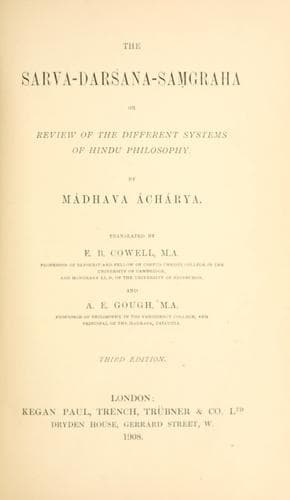
The Sarva-Darsana-Samgraha: Or, Review of the Different Systems of Hindu PhilosophyMadhava
ReligionEastern
The Sarva-Darsana-Samgraha: Or, Review of the Different Systems of Hindu Philosophy
Madhava
Philosophy, Hindu; Philosophy, Indic
"Existence" is that great _summum genus_ which is found in cows,
horses, &c., differentiated by the various subjects in which it
resides; and the inferior species, "cow," "horse," &c., are not really
different from it; for the species "cow" and "horse" (_gotva_ and
_aśvatva_) are not really new subjects, but each is "existence" as
residing in the subject "cow" and "horse." Therefore all words, as
expressing definite meanings, ultimately rest on that one _summum
genus_ existence, which is differentiated by the various subjects,
cows, &c., in which it resides; and hence "existence" is the meaning
of the stem-word (_prátipadika_). A "root" is sometimes defined as
that which expresses _bháva_;[333] now, as _bháva_ is "existence," the
meaning of a root is really existence.[334] Others say that a root
should be defined as that which expresses "action" (_kriyá_); but here
again the meaning of a root will really be "existence," since this
"action" will be a genus, as it is declared to reside in many
subjects, in accordance with the common definition of a genus, in the
line--
"Others say that action (_kriyá_) is a genus, residing in
many individuals."
So, too, if we accept Páṇini's definition (v. 1, 119), "Let the
affixes _tva_ and _tal_ come after a word [denoting anything], when we
speak of the nature (_bháva_) thereof," it is clear from the very fact
that abstract terms ending in _tva_ or _tá_ [as _aśvatva_ and
_aśvatá_] are used in the sense of _bháva_, that they do express
"existence." "This is pure existence" from its being free from all
coming into being or ceasing to be; it is eternal, since, as all
phenomena are developments thereof, it is devoid of any limit in
space, time, or substance: this existence is called "the great soul."
Such is the meaning of Hari's two _kárikás_ quoted above. So, too, it
is laid down in the discussion on _sambandha_ [in Hari's verses] that
the ultimate meaning of all words is that something whose
characteristic is perfect knowledge of the real meaning of the word
Substance.
"The true Reality is ascertained by its illusory forms; the true
substance is declared by words through illusory disguises; as the
object, 'Devadatta's house,' is apprehended by a transitory cause of
discrimination,[335] but by the word 'house' itself, the pure idea
[without owners] is expressed."[336]
So, too, the author of the Mahábháshya, when explaining the
Várttika,[337] "a word, its meaning, and its connection being fixed,"
in the passage beginning "substance is eternal," has shown that the
meaning of all words is Brahman, expressed by the word "substance" and
determined by various unreal[338] conditions [as "the nature of
horse," &c.]
Public-domain text, read in full here on John Shaqi.
Reviews
Reviews
No reviews yet
Be the first to share your thoughts on this work.
Elsewhere in the archive
Join the Discussion
Join the discussion
Sign in to leave a comment or review.
Sign InorCreate an account