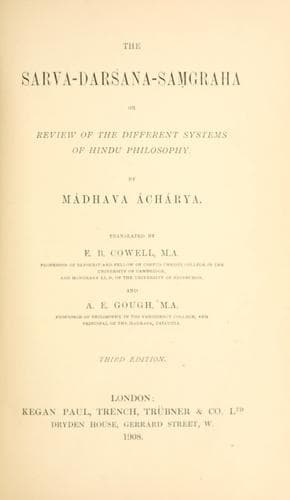
The Sarva-Darsana-Samgraha: Or, Review of the Different Systems of Hindu PhilosophyMadhava
ReligionEastern
The Sarva-Darsana-Samgraha: Or, Review of the Different Systems of Hindu Philosophy
Madhava
Philosophy, Hindu; Philosophy, Indic
[Footnote 309: _Śabdánuśásana_, if judged by the apparent sense of
Páṇini, ii. 2, 14, would be a wrong compound; but it is not so,
because ii. 2, 14 must be interpreted in the sense of ii. 3, 66,
whence it follows that the compound would only be wrong if there were
an agent expressed _as well as_ an object, _i.e._, if such a word as
_ácháryeṇa_ followed. In the example given, we cannot say _áścharyo
godoho śikshitena gopálena_ (as it would violate ii. 2, 14), neither
can we say _áścharyo gaváṃ doho' śikshitasya gopálasya_ (as it would
violate ii. 3, 66).]
[Footnote 310: That is, the _ubhayaprápti_ of ii. 3, 66, is a
_bahuvríhi_ agreeing with _kṛiti_ in ii. 3, 65. These points are all
discussed at some length in the Commentaries on Páṇini.]
[Footnote 311: These actually occur in the Commentaries to Páṇini, ii.
2, 8; iii. 3, 117, &c.]
[Footnote 312: This takes in all cases of relation, _sambandha_
(_i.e._, _shashṭhí-sambandha_).]
[Footnote 313: As in such rules as vi. 2, 139.]
[Footnote 314: These compounds occur in Páṇini's own sútras (i. 4, 30,
and i. 4, 55), and would violate his own rule in ii. 2, 15, if we were
to interpret the latter without some such saving modification as
_shashṭhí śeshe_.]
[Footnote 315: The very word _śabda_ in _śabdánuśásanam_ implies the
Veda, since this is pre-eminently _śabda_.]
[Footnote 316: Compare Max Müller, _Sansk. Liter._, p. 113. It is
quoted as from the Veda in the Mahábháshya.]
[Footnote 317: In the Calcutta text, p. 138, dele _daṇḍa_ in line 3
after _bhavet_, and insert it in line 4 after _śabdánám_.]
[Footnote 318: As in the so-called _pada_ text.]
[Footnote 319: See Ballantyne's _Mahábháshya_, pp. 12, 64.]
[Footnote 320: _Achíkramata_ seems put here as a purposely false form
of the frequentative of _kram_ for _achaṅkramyata_.]
[Footnote 321: Or it may mean "the developed universe." Compare the
lines of Bhartṛihari which immediately follow.]
[Footnote 322: One would naturally supply _śabdasya_ after _sámyam_,
but the Mahábháshya has _naḥ sámyam_ (see Ballantyne's ed., p. 27).]
[Footnote 323: _I.e._, prepositions used separately as governing cases
of their own, and not (as usually in Sanskrit) in composition.]
[Footnote 324: The _karmapravachaníyas_ imply a verb other than the one
expressed, and they are said to determine the relation which is produced
by this understood verb. Thus in the example, _Śákalyasaṃhitám anu
právarshat_, "he rained after the Śákalya hymns," _anu_ implies an
understood verb _niśamya_, "having heard," and this verb shows that there
is a relation of cause and effect between the hymns and the rain. This
_anu_ is said to determine this relation.]
[Footnote 325: See Ballantyne's ed., p. 10.]
[Footnote 326: This is not very clear, the _anu_ in _anugraha_ might
mean _krameṇa_, and so imply the successive order of the letters.]
[Footnote 327: In the Calcutta edition, p. 142, line 11, I read
_kalpam_ for _kalpanam_.]
Public-domain text, read in full here on John Shaqi.
Reviews
Reviews
No reviews yet
Be the first to share your thoughts on this work.
Elsewhere in the archive
Join the Discussion
Join the discussion
Sign in to leave a comment or review.
Sign InorCreate an account