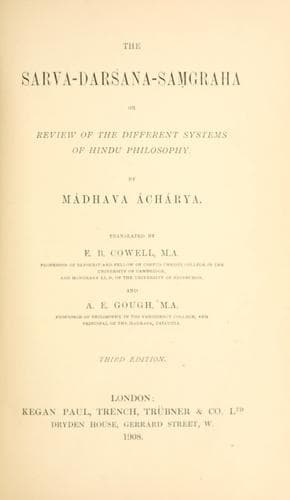
The Sarva-Darsana-Samgraha: Or, Review of the Different Systems of Hindu PhilosophyMadhava
ReligionEastern
The Sarva-Darsana-Samgraha: Or, Review of the Different Systems of Hindu Philosophy
Madhava
Philosophy, Hindu; Philosophy, Indic
[Footnote 328: In p. 142, line 3, I add _viná_ after _nimittam_.]
[Footnote 329: The ghaṭṭa is the place where dues and taxes are
collected. Some one anxious to evade payment is going by a private way
by night, but he arrives at the tax-collector's house just as day
dawns and is thus caught. Hence the proverb means _uddeśyásiddhi_.]
[Footnote 330: In p. 143, line 13, I read _sphoṭakabhávam_ for
_sphoṭábhávam_.]
[Footnote 331: Cf. Ballantyne's Transl. of the Mahábháshya, pp. 9,
32.]
[Footnote 332: The Mímáṃsâ holds that a word means the genus (_játi_)
and not the individual (_vyakti_); the Nyáya holds that a word means
an individual as distinguished by such and such a genus (or species).]
[Footnote 333: Cf. Rig-Veda Prátiś. xii. 5.]
[Footnote 334: He here is trying to show that his view is confirmed by
the commonly received definitions of some grammatical terms.]
[Footnote 335: Since Devadatta is only its transient owner.]
[Footnote 336: So by the words "horse," "cow," &c., Brahman is really
meant, the one abiding existence.]
[Footnote 337: Cf. Ballantyne's Mahábháshya, pp. 44, 50.]
[Footnote 338: In p. 145, line 8, read _asatya_ for _aśvattha_.]
[Footnote 339: We have here the well-known four grammatical
categories, _játi_, _guna_, _dravya_ or _saṅjná_, and _kriyá_.]
[Footnote 340: But cf. Siddh. Muktáv., p. 6, line 12.]
[Footnote 341: Thus we read in the Siddhánta Muktávali, p. 82, that
the Mímáṃsá holds that a word means the genus and not the individual,
since otherwise there would be _vyabhichára_ and _ánantya_ (cf. also
Maheśachandra Nyáyaratna's note, Kávya-prakáśa, p. 10). If a word is
held to mean only _one_ individual, there will be the first fault, as
it will "wander away" and equally express others which it should not
include; if it is held to mean _many_ individuals, it will have an
endless variety of meanings and be "indefinite."]
[Footnote 342: This seems the meaning of the text as printed _tasmát
dvayaṃ satyam_, but I should prefer to read conjecturally _tasmád
advayaṃ satyam_, "therefore non-duality is the truth."]
[Footnote 343: _Scil._ they can only be the absolute Brahman who alone
exists.]
[Footnote 344: _Scil._ the individual soul (_jíva_) and Brahman.]
[Footnote 345: The _Saṃvṛiti_ of the text seems to correspond to the
_ávaraṇa_ so frequent in Vedánta books.]
[Footnote 346: This passage is quoted in the Maitrí Upanishad, vi.
22.]
[Footnote 347: _Adhividyam_ occurs in Taitt. Upanishad, i. 3, 1, where
it is explained by [']Saṃkara as _vidyásv adhi yad dar[']sanaṃ tad
adhividyam_.]
CHAPTER XIV.
THE SÁNKHYA-DARŚANA.
Public-domain text, read in full here on John Shaqi.
Reviews
Reviews
No reviews yet
Be the first to share your thoughts on this work.
Elsewhere in the archive
Join the Discussion
Join the discussion
Sign in to leave a comment or review.
Sign InorCreate an account