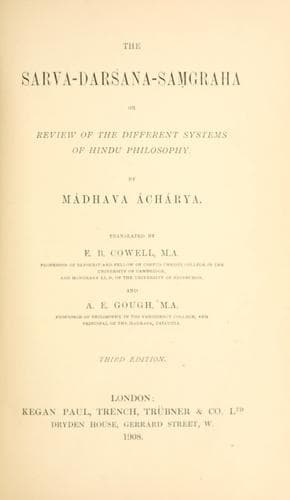
The Sarva-Darsana-Samgraha: Or, Review of the Different Systems of Hindu PhilosophyMadhava
ReligionEastern
The Sarva-Darsana-Samgraha: Or, Review of the Different Systems of Hindu Philosophy
Madhava
Philosophy, Hindu; Philosophy, Indic
"Egoism" (_asmitá_) is the notion that the two separate things, the
soul and the quality of purity,[418] are one and the same, as is said
(ii. 6), "Egoism is the identifying of the seer with the power of
sight." "Desire" (_rága_) is a longing, in the shape of a thirst, for
the means of enjoyment, preceded by the remembrance of enjoyment, on
the part of one who has known joy. "Aversion" (_dvesha_) is the
feeling of blame felt towards the means of pain, similarly preceded by
the remembrance of pain, on the part of one who has known it. This is
expressed in the two aphorisms, "Desire is what dwells on pleasure;"
"Aversion is what dwells on pain" (ii. 7, 8).
Here a grammatical question may be raised, "Are we to consider this
word _anuśayin_ ('dwelling') as formed by the _kṛit_ affix _ṇini_ in
the sense of 'what is habitual,' or the _taddhita_ affix _ini_ in the
sense of _matup_? It cannot be the former, since the affix _ṇini_
cannot be used after a root compounded with a preposition as _anuśí_;
for, as the word _supi_ has already occurred in the Sútra, iii. 2, 4,
and has been exerting its influence in the following sútras, this word
must have been introduced a second time in the Sútra, iii. 2, 78,
_supy ajátau ṇinis táchchhílye_,[419] on purpose to exclude
prepositions, as these have no case terminations; and even if we did
strain a point to allow them, still it would follow by the Sútra, vii.
2, 115, _acho ñṇiti_,[420] that the radical vowel must be subject to
_vṛiddhi_, and so the word must be _anuśáyin_, in accordance with the
analogy of such words as _atiśáyin_, &c. Nor is the latter view
tenable (_i.e._, that it is the _taddhita_ affix _ini_[421]), since
_ini_ is forbidden by the technical verse--
'These two affixes[422] are not used after a monosyllable
nor a _kṛit_ formation, nor a word meaning 'genus,' nor with
a word in the locative case;'
and the word _anuśaya_ is clearly a _kṛit_ formation as it ends with
the affix _ach_[423] [which brings it under this prohibition, and so
renders it insusceptible of the affix _ini_]. Consequently, the word
_anuśayin_ in the Yoga aphorism is one the formation of which it is
very hard to justify."[424] This cavil, however, is not to be
admitted; since the rule is only to be understood as applying
generally, not absolutely, as it does not refer to something of
essential importance. Hence the author of the Vṛitti has said--
"The word _iti_, as implying the idea of popular
acceptation, is everywhere connected with the examples of
this rule[425] [_i.e._, it is not an absolute law]."
Public-domain text, read in full here on John Shaqi.
Reviews
Reviews
No reviews yet
Be the first to share your thoughts on this work.
Elsewhere in the archive
Join the Discussion
Join the discussion
Sign in to leave a comment or review.
Sign InorCreate an account