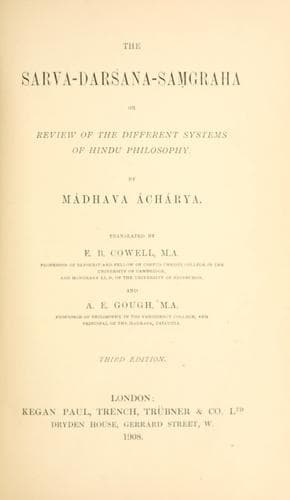
The Sarva-Darsana-Samgraha: Or, Review of the Different Systems of Hindu PhilosophyMadhava
ReligionEastern
The Sarva-Darsana-Samgraha: Or, Review of the Different Systems of Hindu Philosophy
Madhava
Philosophy, Hindu; Philosophy, Indic
Váchaspati also says,[411] "The connection of words and their meanings
depends on general consent for its certainty; and since we
occasionally see that a _tatpurusha_ negation, where the latter
portion is properly predominant, may overpower the direct meaning of
this latter portion by its contradiction of it, we conclude that even
here too [in _avidyá_] the real meaning is something contrary to
_vidyá_" [_i.e._, the negative "non-knowledge" becomes ultimately the
positive "ignorance"[412]]. It is with a view to this that it is said
in the Yoga Aphorisms [ii. 5], "Ignorance is the notion that the
non-eternal, the impure, pain, and the non-soul are (severally)
eternal, pure, pleasure, and soul." _Viparyaya_, "misconception," is
defined as "the imagining of a thing in what is not that thing,"[413]
[_i.e._, in its opposite]; as, for instance, the imagining the
"eternal" in a "non-eternal" thing, _i.e._, a jar, or the imagining
the "pure" in the "impure" body,[414] when it has been declared by a
proverbial couplet[415]--
"The wise recognise the body as impure, from its original
place [the womb],--from its primal seed,--from its
composition [of humours, &c.],--from perspiration,--from
death [as even a Bráhman's body defiles],--and from the fact
that it has to be made pure by rites."
So,--in accordance with the principle enounced in the aphorism (ii.
15), "To the discriminating everything is simply pain, through the
pain which arises in the ultimate issue of everything,[416] or through
the anxiety to secure it [while it is enjoyed], or through the latent
impressions which it leaves behind, and also from the mutual
opposition of the influences of the three qualities" [in the form of
pleasure, pain, and stupid indifference],--ignorance transfers the
idea of "pleasure" to what is really "pain," as, _e.g._, garlands,
sandal-wood, women, &c.; and similarly it conceives the "non-soul,"
_e.g._, the body, &c., as the "soul." As it has been said--
"But ignorance is when living beings transfer the notion of
'soul' to the 'non-soul,' as the body, &c.;
"This causes bondage; but in the abolition thereof is
liberation."
Thus this ignorance consists of four kinds.[417]
But [it may be objected] in these four special kinds of ignorance
should there not be given some general definition applying to them
all, as otherwise their special characteristics cannot be
established? For thus it has been said by Bhaṭṭa Kumárila--
"'Without some general definition, a more special definition
cannot be given by itself; therefore it must not be even
mentioned here.'"
This, however, must not be urged here, as it is sufficiently met by
the general definition of misconception, already adduced above, as
"the imagining of a thing in its opposite."
Public-domain text, read in full here on John Shaqi.
Reviews
Reviews
No reviews yet
Be the first to share your thoughts on this work.
Elsewhere in the archive
Join the Discussion
Join the discussion
Sign in to leave a comment or review.
Sign InorCreate an account