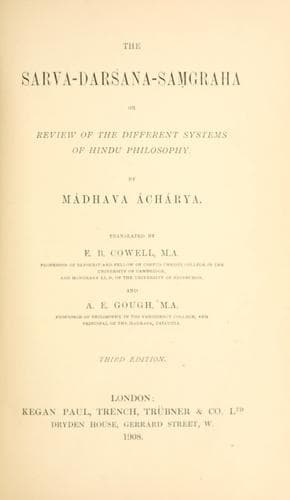
The Sarva-Darsana-Samgraha: Or, Review of the Different Systems of Hindu PhilosophyMadhava
ReligionEastern
The Sarva-Darsana-Samgraha: Or, Review of the Different Systems of Hindu Philosophy
Madhava
Philosophy, Hindu; Philosophy, Indic
"The threefold impurity of the _mantra_. This is the
'purification' (_vimalí-karaṇa_).
"The utterance of the _jyotir-mantra_, together with Om, and
the _mantras_ of Vyoman and Agni,
"And the sprinkling of every letter with water from a bunch
of kuśa grass,
"With the mystical seed of water[433] duly muttered,--this
is held to be the 'fattening' (_ápyáyana_).
"The satiating libation over the _mantra_ with
_mantra_-hallowed water is the 'satisfying' (_tarpaṇa_).
"The joining of the _mantra_ with Om and the 'seeds' of
Máyá[434] and Ramá[435] is called its 'illumining'
(_dípana_).
"The non-publication of the _mantra_ which is being
muttered--this is its 'concealing' (_gopana_).
"These ten consecrating ceremonies are kept close in all
_tantras_;
"And the adept who practises them according to the tradition
obtains his desire;
"And _ruddha_, _kílita_, _vichhinna_, _supta_, _śapta_, and
the rest,
"All these faults in the _mantra_ rites are abolished by
these excellent consecrations."
But enough of this venturing to make public the _tantra_ mysteries
connected with _mantras_, which has suddenly led us astray like an
unexpected Bacchanalian dance.[436]
The third form of practical _yoga_, "resignation to the Lord"
(_íśvara-praṇidhána_), is the consigning all one's works, whether
mentioned or not, without regard to fruit, to the Supreme Lord, the
Supremely Venerable. As it has been said--
"Whatever I do, good or bad, voluntary or involuntary,
"That is all made over to thee; I act as impelled by thee."
This self-resignation is also sometimes defined as "the surrender of
the fruits of one's actions," and is thus a peculiar kind of faith,
since most men act only with a selfish regard to the fruit. Thus it is
sung in the Bhagavad Gítá [ii. 47]--
"Let thy sole concern be with action and never with the
fruits;
"Be not attracted by the fruit of the action, nor be thou
attached to inaction."
The harmfulness of aiming at the fruit of an action has been declared
by the venerable Nílakaṇṭha-bháratí--
"Even a penance accomplished by great effort, but vitiated
by desire,
"Produces only disgust in the Great Lord, like milk which
has been licked by a dog."
Now this prescribed practice of mortification, recitation, and
resignation is itself called _yoga_, because it is a means for
producing _yoga_, this being an instance of the function of words
called "superimponent pure Indication," as in the well-known example,
"Butter is longevity." "Indication" is the establishing of another
meaning of a word from the incompatibility of its principal meaning
with the rest of the sentence, and from the connection of this new
meaning with the former; it is twofold, as founded on notoriety or on
a motive. This has been declared in the _Kávya-prakáśa_ [ii. 9]--
Public-domain text, read in full here on John Shaqi.
Reviews
Reviews
No reviews yet
Be the first to share your thoughts on this work.
Elsewhere in the archive
Join the Discussion
Join the discussion
Sign in to leave a comment or review.
Sign InorCreate an account