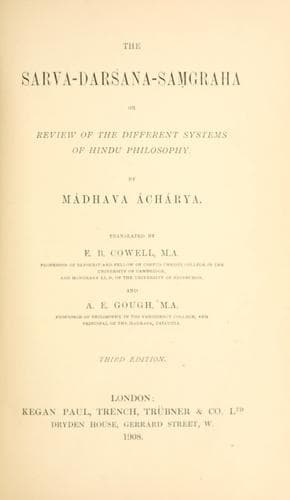
The Sarva-Darsana-Samgraha: Or, Review of the Different Systems of Hindu PhilosophyMadhava
ReligionEastern
The Sarva-Darsana-Samgraha: Or, Review of the Different Systems of Hindu Philosophy
Madhava
Philosophy, Hindu; Philosophy, Indic
"When, in consequence of the incompatibility of the
principal meaning of a word, and yet in connection with it,
another meaning is indicated through notoriety or a motive,
this is 'Indication,' the superadded function of the word."
Now the word "this" [_i.e._, _tat_ in the neuter, which the neuter
_yat_ in the extract would have naturally led us to expect instead of
the feminine _sá_] would have signified some neuter word, like
"implying," which is involved as a subordinate part of the verb "is
indicated." But _sá_ is used in the feminine [by attraction to agree
with _lakshaṇá_], "this is indication," _i.e._, the neuter "this" is
put in the feminine through its dependence on the predicate. This has
been explained by Kaiyaṭa, "Of those pronouns which imply the identity
of the subject and the predicate, the former takes the gender of the
former, the latter of the latter."[437] Now "expert (_kuśala_) in
business" is an example of Indication from notoriety; for the word
_kuśala_, which is significant in its parts by being analysed
etymologically as _kuśaṃ_ + _láti_, "one who gathers kuśa grass for
the sacrifice," is here employed to mean "expert" through the relation
of a similarity in character, as both are persons of discernment; and
this does not need a motive any more than Denotation does, since each
is the using a word in its recognised conventional sense in accordance
with the immemorial tradition of the elders. Hence it has been said--
"Some instances of 'indication' are known by notoriety from
their immediate significance, just as is the case in
'denotation' [the primary power of a word]."
Therefore indication based on notoriety has no regard to any motive.
Although a word, when it is employed, first establishes its principal
meaning, and then by that meaning a second meaning is subsequently
indicated, and so indication belongs properly to the principal meaning
and not to the word; still, since it is superadded to the word which
originally established the primary meaning, it is called [improperly
by metonymy] a function of the word. It was with a view to this that
the author of the Kávya-prakáśa used the expression, "This is
'Indication,' the superadded function of the word." But the indication
based on a motive is of six kinds: 1. inclusive indication,[438] as
"the lances enter" [where we really mean "men _with_ the lances"]; 2.
indicative indication, as "the benches shout" [where the spectators
are meant _without_ the benches]; 3. qualified[439] superimponent
indication, as "the man of the Panjáb is an ox" [here the object is
not swallowed up in the simile]; 4. qualified introsusceptive
indication, as "that ox" [here the man is swallowed up in the simile];
5. pure superimponent indication, as "_ghí_ is life;" 6. pure
introsusceptive indication, as "verily this is life." This has been
all explained in the Kávya-prakáśa [ii. 10-12]. But enough of this
churning of the depths of rhetorical discussions.
Public-domain text, read in full here on John Shaqi.
Reviews
Reviews
No reviews yet
Be the first to share your thoughts on this work.
Elsewhere in the archive
Join the Discussion
Join the discussion
Sign in to leave a comment or review.
Sign InorCreate an account