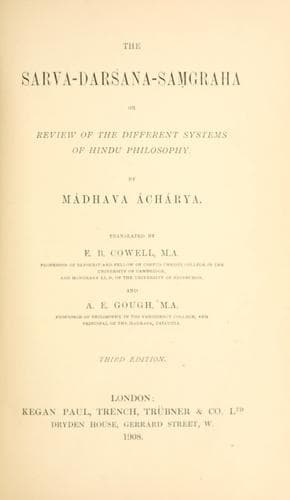
The Sarva-Darsana-Samgraha: Or, Review of the Different Systems of Hindu PhilosophyMadhava
ReligionEastern
The Sarva-Darsana-Samgraha: Or, Review of the Different Systems of Hindu Philosophy
Madhava
Philosophy, Hindu; Philosophy, Indic
The descriptions of the others must be sought in that work.--When this
steadiness of posture has been attained, "regulation of the breath" is
practised, and this consists in "a cutting short of the motion of
inspiration and expiration" [ii. 49]. Inspiration is the drawing in of
the external air; expiration is the expelling of the air within the
body; and "regulation of the breath" is the cessation of activity in
both movements. "But [it may be objected] this cannot be accepted as a
general definition of 'regulation of breath,' since it fails to apply
to the special kinds, as _rechaka_, _púraka_, and _kumbhaka_." We
reply that there is here no fault in the definition, since the
"cutting short of the motion of inspiration and expiration" is found
in all these special kinds. Thus _rechaka_, which is the expulsion of
the air within the body, is only that regulation of the breath, which
has been mentioned before as "expiration;" and _púraka_, which is the
[regulated] retention of the external air within the body, is the
"inspiration;" and _kumbhaka_ is the internal suspension of breathing,
when the vital air, called _práṇa_, remains motionless like water in a
jar (_kumbha_). Thus the "cutting short of the motion of inspiration
and expiration" applies to all, and consequently the objector's doubt
is needless.
Now this air, beginning from sunrise, remains two _ghaṭikás_ and a
half[440] in each artery[441] (_náḍi_), like the revolving buckets on
a waterwheel.[442] Thus in the course of a day and night there are
produced 21,600 inspirations and expirations. Hence it has been said
by those who know the secret of transmitting the _mantras_, concerning
the transmission of the _ajapámantra_[443]--
"Six hundred to Gaṇeśa, six thousand to the self-existent
Brahman,
"Six thousand to Vishṇu, six thousand to Śiva,
"One thousand to the Guru (Bṛihaspati), one thousand to the
Supreme Soul,
"And one thousand to the soul: thus I make over the
performed muttering."
So at the time of the passing of the air through the arteries, the
elements, earth, &c., must be understood, according to their different
colours, by those who wish to obtain the highest good. This has been
thus explained by the wise--
"Let each artery convey the air two _ghaṭís_ and a half from
sunrise.
"There is a continual resemblance of the two arteries[444]
to the buckets on a revolving waterwheel.
"Nine hundred inspirations and expirations of the air take
place [in the hour],
"And all combined produce the total of twenty-one thousand
six hundred in a day and night.
"The time that is spent in uttering thirty-six _guṇa_
letters,[445]
"That time elapses while the air passes along in the
interval between two arteries.
"There are five elements in each of the two conducting
arteries,--
"They bear it along day and night; these are to be known by
the self-restrained.
Public-domain text, read in full here on John Shaqi.
Reviews
Reviews
No reviews yet
Be the first to share your thoughts on this work.
Elsewhere in the archive
Join the Discussion
Join the discussion
Sign in to leave a comment or review.
Sign InorCreate an account