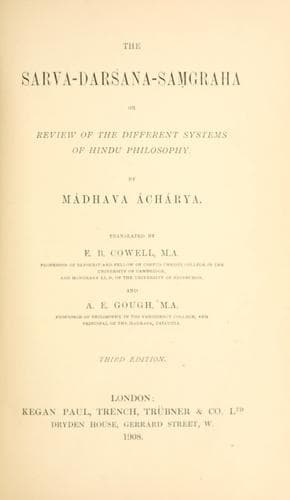
The Sarva-Darsana-Samgraha: Or, Review of the Different Systems of Hindu PhilosophyMadhava
ReligionEastern
The Sarva-Darsana-Samgraha: Or, Review of the Different Systems of Hindu Philosophy
Madhava
Philosophy, Hindu; Philosophy, Indic
"Fire bears above, water below; air moves across;
"Earth in the half-hollow; ether moves everywhere.
"They bear along in order,--air, fire, water, earth, ether;
"This is to be known in its due order in the two conducting
arteries.
"The _palas_[446] of earth are fifty, of water forty,
"Of fire thirty, of air twenty, of ether ten.
"This is the amount of time taken for the bearing; but the
reason that the two arteries are so disturbed
"Is that earth has five properties,[447] water four,
"Fire has three, air two, and ether one.
"There are ten _palas_ for each property; hence earth has
fifty _palas_,
"And each, from water downwards, loses successively. Now the
five properties of earth
"Are odour, savour, colour, tangibility, and audibleness;
and these decrease one by one.
"The two elements, earth and water, produce their fruit by
the influence of 'quiet,'
"But fire, air, and ether by the influence of 'brightness,'
'restlessness,' and 'immensity.'[448]
"The characteristic signs of earth, water, fire, air, and
ether are now declared;--
"Of the first steadfastness of mind; through the coldness of
the second arises desire;
"From the third anger and grief; from the fourth fickleness
of mind;
"From the fifth the absence of any object, or mental
impressions of latent merit.
"Let the devotee place his thumbs in his ears, and a middle
finger in each nostril,
"And the little finger and the one next to it in the corners
of his mouth, and the two remaining fingers in the corners
of his eyes,
"Then there will arise in due order the knowledge of the
earth and the other elements within him,
"The first four by yellow, white, dark red, and dark blue
spots,[449]--the ether has no symbol."
When the element air is thus comprehended and its restraint is
accomplished, the evil influence of works which concealed
discriminating knowledge is destroyed [ii. 52]; hence it has been
said--
"There is no austerity superior to regulation of the
breath."[450]
And again--
"As the dross of metals, when they are melted, is consumed,
"So the serpents of the senses are consumed by regulation of
the breath."[451]
Now in this way, having his mind purified by the "forbearances" and
the other things subservient to concentration, the devotee is to
attain "self-mastery" (_saṃyama_)[452] and "restraint" (_pratyáhára_).
"Restraint" is the accommodation of the senses, as the eye, &c., to
the nature of the mind,[453] which is intent on the soul's unaltered
nature, while they abandon all concernment with their own several
objects, which might excite desire or anger or stupid indifference.
This is expressed by the etymology of the word; the senses are drawn
to it (_á_ + _hṛi_), away from them (_pratípa_).
Public-domain text, read in full here on John Shaqi.
Reviews
Reviews
No reviews yet
Be the first to share your thoughts on this work.
Elsewhere in the archive
Join the Discussion
Join the discussion
Sign in to leave a comment or review.
Sign InorCreate an account