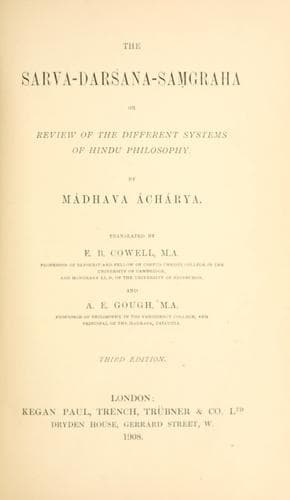
The Sarva-Darsana-Samgraha: Or, Review of the Different Systems of Hindu PhilosophyMadhava
ReligionEastern
The Sarva-Darsana-Samgraha: Or, Review of the Different Systems of Hindu Philosophy
Madhava
Philosophy, Hindu; Philosophy, Indic
We, however, deny this, and maintain that the true meaning of the
definition is simply this,--that whatever fact or mark we take to
determine definitely, in reference to the topic, the major term which
our condition is invariably to accompany, that same fact or mark must
be equally taken to determine the middle term which our said condition
is not invariably to accompany. Thus (_a_) the "being produced from
feeding on vegetables" invariably accompanies "a dark colour," as
determined by the fact that it is Mitrá's son, whose dark colour is
discussed [and this very fact is the alleged middle term of the
argument; but the pretended contradictory instance of the dark jar is
not in point, as this was not the topic discussed]. (_b_) Again,
"possessing proportionate form" invariably accompanies perceptibility
as determined by the fact that the thing perceived is an external
object; while it does not invariably accompany the alleged middle term
"the being the site of touch," which is equally to be determined by
the fact that the thing perceived is to be an external object.[472]
(_c_) Again, in the argument "destruction is perishable from its being
produced," the "being included in some positive category of existence"
invariably accompanies the major term "perishable," when determined by
the attribute of being produced. [And this is the middle term
advanced; and therefore the alleged contradictory instance,
"antecedent non-existence," is not in point, since nobody pretends
that this is produced at all.]
But it is to be observed that there is nothing of this kind in valid
middle terms, _i.e._, there is nothing _there_ which invariably
accompanies the major term when determined by a certain fact or mark,
and does not so accompany the middle term when similarly determined.
This is peculiar to the so-called condition. [Should the reader object
that "in each of our previous examples there has been given a separate
determining mark or attribute which was to be found in each of the
cases included under each; how then, in the absence of some general
rule, are we to find out what this determining mark is to be in any
particular given case?" We reply that] in the case of any middle term
which is too general, the required general rule consists in the
constant presence of one or other of the following alternatives, viz.,
that the subjects thus to be included are either (i.) the acknowledged
site of the major term, and also the site of the condition,[473] or
else (ii.) the acknowledged site of the too general middle term, but
excluding the said condition;[474] and it will be when the case is
determined by the presence of one or other of these alternatives that
the condition will be considered as "always accompanying the major
term, and not always accompanying the middle term."[475]
Public-domain text, read in full here on John Shaqi.
Reviews
Reviews
No reviews yet
Be the first to share your thoughts on this work.
Elsewhere in the archive
Join the Discussion
Join the discussion
Sign in to leave a comment or review.
Sign InorCreate an account