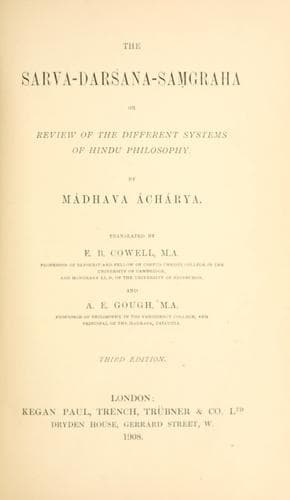
The Sarva-Darsana-Samgraha: Or, Review of the Different Systems of Hindu PhilosophyMadhava
ReligionEastern
The Sarva-Darsana-Samgraha: Or, Review of the Different Systems of Hindu Philosophy
Madhava
Philosophy, Hindu; Philosophy, Indic
Our author now proceeds to define the _upádhi_ or condition,[468]
which is used to stop our acquiescence in a universal proposition as
laid down by another person;--"that which always accompanies," &c. The
meaning of this is that the so-called condition, while it invariably
accompanies that which is accepted as the major term, does not thus
invariably accompany that which our opponent puts forward as his
middle term. [Thus in the false argument, "The mountain has smoke
because it has fire," we may advance "wet fuel," or rather "the being
produced from wet fuel," as an _upádhi_, since "wet fuel" is
necessarily found wherever smoke is, but not always where fire is, as
_e.g._, in a red-hot iron ball.]
"But," the opponent may suggest, "if this were true, would it not
follow that (_a_) in the case of the too wide middle term in the
argument, 'This [second] son of Mitrá's, whom I have not seen, must be
dark because he is Mitrá's son,' we could not allege 'the being
produced from feeding on vegetables'[469] as a 'condition,'--inasmuch
as it does not invariably accompany a dark colour, since a dark colour
does also reside in things like [unbaked] jars, &c., which have
nothing to do with feeding on vegetables? (_b_) Again, in the
argument, 'The air must be perceptible to sense[470] because it is the
site of touch,' we could not allege the 'possessing proportionate
form' as a 'condition;' because perceptibility [to the internal sense]
is found in the soul, &c., and yet soul, &c., have no form [and
therefore the 'possessing proportionate form' does not invariably
accompany perceptibility]. (_c_) Again, in the argument,'Destruction
is itself perishable, because it is produced,' we could not allege as
a 'condition' the 'being included in some positive category of
existence'[471] [destruction being a form of non-existence, called
"emergent," _dvaṃśábháva_], inasmuch as perishability is found in
antecedent non-existence, and this certainly cannot be said to be
included in any positive category of existence."
Public-domain text, read in full here on John Shaqi.
Reviews
Reviews
No reviews yet
Be the first to share your thoughts on this work.
Elsewhere in the archive
Join the Discussion
Join the discussion
Sign in to leave a comment or review.
Sign InorCreate an account