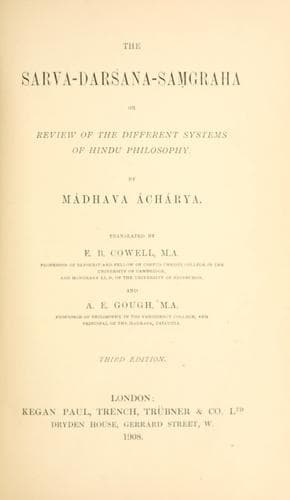
The Sarva-Darsana-Samgraha: Or, Review of the Different Systems of Hindu PhilosophyMadhava
ReligionEastern
The Sarva-Darsana-Samgraha: Or, Review of the Different Systems of Hindu Philosophy
Madhava
Philosophy, Hindu; Philosophy, Indic
[But an objector might here interpose, "If your definition of a
condition be correct, surely a pretended condition which fulfils your
definition can always be found even in the case of a valid middle
term. For instance, in the stock argument 'the mountain must have fire
because it has smoke,' we may assume as our pretended condition 'the
being always found elsewhere than in the mountain;' since this
certainly does not always 'accompany the middle term,' inasmuch as it
is not found in the mountain itself where the smoke is acknowledged to
be; and yet it apparently does 'always accompany the major term,'
since in every other known case of fire we certainly find it, and as
for the present case you must remember that the presence of fire in
this mountain is the very point in dispute." To this we reply] You
never may take such a condition as "the being always found elsewhere
than in the subject or minor term" (unless this can be proved by some
direct sense-evidence which precludes all dispute); because, in the
first place, you cannot produce any argument to convince your
antagonist that this condition does invariably accompany the major
term [since he naturally maintains that the present case is exactly
one in point against you]; and, secondly, because it is
self-contradictory [as the same nugatory condition may be equally
employed to overthrow the contrary argument].
But if you can establish it by direct sense-evidence, then the "being
always found elsewhere than in the subject" becomes a true condition,
[and serves to render nugatory the false argument which a disputant
tries to establish]. Thus in the illusory argument "the fire must be
non-hot because it is artificial," we can have a valid condition in
"the being always found elsewhere than in fire," since we can prove by
sense-evidence that fire is hot,[479] [thus the _upádhi_ here is a
means of overthrowing the false argument].
Where the fact of its always accompanying the major term, &c., is
disputed, there we have what is called a disputed condition.[480] But
"the being found elsewhere than in the subject" can never be employed
even as a disputed condition, in accordance with the traditional rules
of logical controversy.[481]
E. B. C.
FOOTNOTES:
Public-domain text, read in full here on John Shaqi.
Reviews
Reviews
No reviews yet
Be the first to share your thoughts on this work.
Elsewhere in the archive
Join the Discussion
Join the discussion
Sign in to leave a comment or review.
Sign InorCreate an account