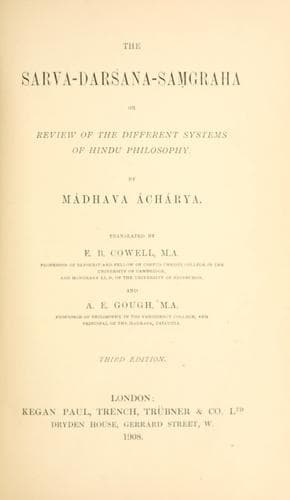
The Sarva-Darsana-Samgraha: Or, Review of the Different Systems of Hindu PhilosophyMadhava
ReligionEastern
The Sarva-Darsana-Samgraha: Or, Review of the Different Systems of Hindu Philosophy
Madhava
Philosophy, Hindu; Philosophy, Indic
[Footnote 468: The _upádhi_ is the "condition" which must be supplied
to restrict a too general middle term. If the middle term, as thus
restricted, is still found in the minor term, the argument is valid;
if not, it fails. Thus, in "The mountain has smoke because it has
fire" (which rests on the false premise that "all fire is accompanied
by smoke"), we must add "wet fuel" as the condition of "fire;" and if
the mountain _has_ wet fuel as well as fire, of course it will have
smoke. Similarly, the alleged argument that "B is dark because he is
Mitrá's son" fails, if we can establish that the dark colour of her
former offspring A depended not on his being her son, but on her
happening to have fed on vegetables instead of ghee. If we can prove
that she still keeps to her old diet, of course our amended middle
term will still prove B to be dark, but not otherwise.]
[Footnote 469: The Hindus think that a child's dark colour comes from
the mother's living on vegetables, while its fair colour comes from
her living on ghee.]
[Footnote 470: By Bháshá-parich. śl. 25, the four elements, earth,
water, air, and fire, are _sparśavat_, but by śl. 27 of these air is
neither _pratyaksha_ nor _rúpavat_.]
[Footnote 471: This condition would imply that we could only argue
from this middle term "the being produced" in cases of positive
existence, not non-existence.]
[Footnote 472: "Soul," of course, is not external; but our topic was
not _soul_, but _air_.]
[Footnote 473: As, _e.g._, the mountain and Mitrá's first son in the
two false arguments, "The mountain has smoke because it has fire"
(when the fire-possessing red-hot iron ball has no smoke), and
"Mitrá's first son A is dark because he is Mitrá's offspring" (when
her second son B is fair). These two subjects possess the respective
_sádhyas_ or major terms "smoke" and "dark colour," and therefore are
respectively the subjects where the conditions "wet fuel" and "the
mother's feeding on vegetables" are to be respectively applied.]
[Footnote 474: As, _e.g._, the red-hot ball of iron and Mitrá's second
son; as these, though possessing the respective middle terms "fire"
and "the being Mitrá's offspring" do not possess the respective
conditions "wet fuel" or "the mother's feeding on vegetables," nor,
consequently, the respective major terms (_sádhya_) "smoke" and "dark
colour."]
[Footnote 475: This will exclude the objected case of "dark jars" in
(_a_), as it falls under neither of these two alternatives; for,
though they are the sites of the _sádhya_ "dark colour," they do not
admit the condition "the feeding on vegetables," nor the middle term
"the being Mitrá's son."]
[Footnote 476: _I.e._, wherever there is fire produced by wet fuel
there is smoke. The condition and the major term are "equipollent" in
their extension.]
[Footnote 477: Where the _hetu_ is found and not the _sádhya_ (as in
the red-hot ball of iron), there the _upádhi_ also is not applicable.]
Public-domain text, read in full here on John Shaqi.
Reviews
Reviews
No reviews yet
Be the first to share your thoughts on this work.
Elsewhere in the archive
Join the Discussion
Join the discussion
Sign in to leave a comment or review.
Sign InorCreate an account