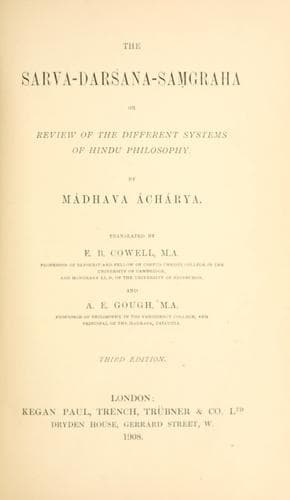
The Sarva-Darsana-Samgraha: Or, Review of the Different Systems of Hindu PhilosophyMadhava
ReligionEastern
The Sarva-Darsana-Samgraha: Or, Review of the Different Systems of Hindu Philosophy
Madhava
Philosophy, Hindu; Philosophy, Indic
[Footnote 76: The _jnána_ is one, but it becomes apparently manifold
by its connection with the senses and external objects.]
[Footnote 77: These are also called the eight _karmans_ in
Govindánanda's gloss, _Ved. Sút._, ii. 2, 33.]
[Footnote 78: The Calcutta MS. reads _ádaraṇíyasya_ for
_ávaraṇíyasya_, in p. 37, last line. But _ávaraṇíya_ may be used for
_ávarana_ (_Páṇ._ iii. 4, 68). Cf. _Yoga Sút._, ii. 52, where Vyása's
Comm. has _ávaraṇíya_.]
[Footnote 79: _Jálavat_? The printed text has _jalavat_.]
[Footnote 80: Umásvámi-?]
[Footnote 81: For the _ságaropama_, see Wilson's _Essays_, vol. i. p.
309. In p. 38, line 16, I read _ityádyuktakálád úrdhvam api_ for the
obscure _ityádyuktaṃ káladurddhánavat_. I also read at the end of the
line _prachyutiḥ sthitiḥ_ for _prachyutisthitiḥ_.]
[Footnote 82: In p. 38, line 18, read _svakáryakaraṇe_.]
[Footnote 83: In p. 39, line 2 and line 5, for _írshyá_ read
_íryá_,--a bad misreading.]
[Footnote 84: In p. 39, line 6, I read _ápadyetá_ for _ápadyatá_.]
[Footnote 85: In p. 39, line 9, for _seshaṇá_ read _saishaṇá_.]
[Footnote 86: In p. 39, line 12, join _nirjantu_ and _jagatítale_.]
[Footnote 87: Mádhava omits the remaining divisions of _saṃvara_.
Wilson, _Essays_, vol. i. p. 311, gives them as _parishahá_,
"endurance," as of a vow; _yatidharma_, "the ten duties of an ascetic,
patience, gentleness," &c.; _bhávaná_, "conviction," such as that
worldly existences are not eternal, &c.; _cháritra_, "virtuous
observance."]
[Footnote 88: In p. 39, line 14, read _ásravasrotaso_.]
[Footnote 89: For _moha_, in line 16, read _moksha_.]
[Footnote 90: In p. 39, line 2 _infra_, I read _yathákála-_ for _yathá
kála-_.]
[Footnote 91: This passage is very difficult and not improbably
corrupt, and my interpretation of it is only conjectural. The ordinary
_nirjará_ is when an action attains its end (like the lulling of a
passion by the gratification), this lull is temporary. That _nirjará_
is "ancillary" which is rendered by asceticism a means to the
attainment of the highest good. The former is _akámá_, "desireless,"
because at the moment the desire is satisfied and so dormant; the
latter is _sakámá_, because the ascetic conquers the lower desire
under the overpowering influence of the higher desire for liberation.]
[Footnote 92: I read _nirodhe_ for _nirodhah_ in p. 40, line 6; cf. p.
37, line 13. The causes of bondage produce the assumption of bodies in
which future actions are to be performed.]
[Footnote 93: Literally "absence of _sanga_."]
[Footnote 94: In p. 41, line 7, read _sapta-bhaṅgí-naya_, see Ved. S.
Gloss., ii. 2, 23.]
[Footnote 95: I cannot understand the words at the end of the first
line, _kim vṛitatadvidheḥ_, and therefore leave them untranslated.]
[Footnote 96: Thus Govindánanda applies it (_Ved. Sút._, ii. 2, 33) to
"may be it is one," "may be it is many," &c.]
[Footnote 97: 'Ακαταληψἱα. This is Śriharsha's tenet in the
_Khaṇḍana-khaṇḍa-khádya_.]
Public-domain text, read in full here on John Shaqi.
Reviews
Reviews
No reviews yet
Be the first to share your thoughts on this work.
Join the Discussion
Join the discussion
Sign in to leave a comment or review.
Sign InorCreate an account