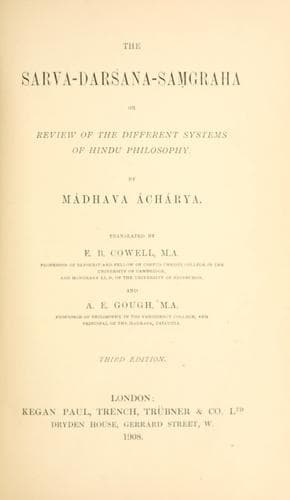
The Sarva-Darsana-Samgraha: Or, Review of the Different Systems of Hindu PhilosophyMadhava
ReligionEastern
The Sarva-Darsana-Samgraha: Or, Review of the Different Systems of Hindu Philosophy
Madhava
Philosophy, Hindu; Philosophy, Indic
[Footnote 98: In p. 42, line 17, for _matenámiśritáni_ read _matena
miśritáni_.]
[Footnote 99: In p. 43, line 2, for _na yasya_ read _nayasya_.]
[Footnote 100: This list is badly printed in the Calcutta edition. It is
really identical with that given in Hemachandra's _Abhidhána-chintámaṇi_,
72, 73; but we must correct the readings to _antaráyás_, _rágadwesháv
aviratiḥ smaraḥ_, and _háso_ for _himsá_. The order of the eighteen
_doshas_ in the Calcutta edition is given by Hemachandra as 4, 5, 1, 2, 3,
10, 11, 12, 7, 9, 17, 16, 18, 8, 6, 15, 13, 14.]
[Footnote 101: In p. 43, line 13, for _vartini_ read _vartiniḥ_.]
[Footnote 102: This seems corrupt,--a line is probably lost.]
[Footnote 103: In last line, for _saṃsrave_ read _saṃvare_.]
[Footnote 104: Does this mean the knowledge of the world, the soul,
the liberated and liberation? These are called _ananta_. See Weber's
_Bhagavatí_, pp. 250, 261-266.]
[Footnote 105: _Sarajoharaṇáh_ is explained by the _rajoharaṇadhárin_
(= _vratin_) of Haláyudha, ii. 189.]
[Footnote 106: Cf. Wilson, _Essays_, i. 340. For _strím_ read _strí_.]
CHAPTER IV.
THE RÁMÁNUJA SYSTEM.
This doctrine of the Árhatas deserves a rational condemnation, for
whereas there is only one thing really existent, the simultaneous
co-existence of existence, non-existence and other modes in a
plurality of really existing things is an impossibility. Nor should
any one say: Granting the impossibility of the co-existence of
existence and non-existence, which are reciprocally contradictory, why
should there not be an alternation between existence and
non-existence? there being the rule that it is action, not _Ens_, that
alternates. Nor let it be supposed that the whole universe is
multiform, in reliance upon the examples of the elephant-headed Gaṇeśa
and of the incarnation of Vishṇu as half man, half lion; for the
elephantine and the leonine nature existing in one part, and the human
in another, and consequently there being no contradiction, those parts
being different, these examples are inapplicable to the maintenance of
a nature multiform as both existent and non-existent in one and the
same part (or place). Again, if any one urge: Let there be existence
in one form, and non-existence in another, and thus both will be
compatible; we rejoin: Not so, for if you had said that at different
times existence and non-existence may be the nature of anything, then
indeed there would have been no vice in your procedure. Nor is it to
be contended: Let the multiformity of the universe be like the length
and shortness which pertain to the same thing (in different
relations); for in these (in this length and shortness) there is no
contrariety, inasmuch as they are contrasted with different objects.
Therefore, for want of evidence, existence and non-existence as
reciprocally contradictory cannot reside at the same time in the same
thing. In a like manner may be understood the refutation of the other
_bhaṅgas_ (Árhata tenets).
Public-domain text, read in full here on John Shaqi.
Reviews
Reviews
No reviews yet
Be the first to share your thoughts on this work.
Join the Discussion
Join the discussion
Sign in to leave a comment or review.
Sign InorCreate an account