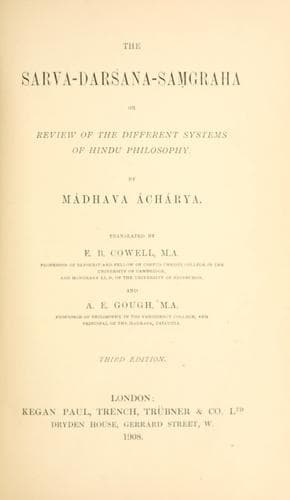
The Sarva-Darsana-Samgraha: Or, Review of the Different Systems of Hindu PhilosophyMadhava
ReligionEastern
The Sarva-Darsana-Samgraha: Or, Review of the Different Systems of Hindu Philosophy
Madhava
Philosophy, Hindu; Philosophy, Indic
Again, we ask, is this doctrine of the seven _bhaṅgas_, which lies at
the base of all this, itself uniform (as excluding one contradictory),
or multiform (as conciliating contradictories). If it is uniform,
there will emerge a contradiction to your thesis that all things are
multiform; if it is multiform, you have not proved what you wished to
prove, a multiform statement (as both existent and non-existent)
proving nothing.[107] In either case, there is rope for a noose for
the neck of the Syád-Vádin.
An admirable author of institutes has the founder of the Árhata
system, dear to the gods (uninquiring pietist), proved himself to be,
when he has not ascertained whether his result is the settling of nine
or of seven principles, nor the investigator who settles them, nor his
organon, the modes of evidence, nor the matter to be evidenced,
whether it be ninefold or not!
In like manner if it be admitted that the soul has (as the Árhatas
say), an extension equal to that of the body, it will follow that in
the case of the souls of ascetics, who by the efficacy of asceticism
assume a plurality of bodies, there is a differentiation of the soul
for each of those bodies. A soul of the size of a human body would not
(in the course of its transmigrations) be able to occupy the whole
body of an elephant; and again, when it laid aside its elephantine
body to enter into that of an ant, it would lose its capacity of
filling its former frame. And it cannot be supposed that the soul
resides successively in the human, elephantine, and other bodies, like
the light of a lamp which is capable of contraction and expansion,
according as it occupies the interior of a little station on the
road-side in which travellers are supplied with water, or the interior
of a stately mansion; for it would follow (from such a supposition)
that the soul being susceptible of modifications and consequently
non-eternal, there would be a loss of merits and a fruition of good
and evil unmerited.
As if then we had thrown their best wrestler, the redargution of the
rest of their categories may be anticipated from this exposition of
the manner in which their treatment of the soul has been vitiated.
Their doctrine, therefore, as repugnant to the eternal, infallible
revelation, cannot be adopted. The venerated Vyása accordingly
propounded the aphorism (ii. 2, 33), "Nay, because it is impossible in
one;" and this same aphorism has been analysed by Rámánuja with the
express purpose of shutting out the doctrine of the Jainas. The tenets
of Rámánuja are as follows:--Three categories are established, as
soul, not-soul, and Lord; or as subject, object, and supreme disposer.
Thus it has been said--
"Lord, soul, and not-soul are the triad of principles: Hari
(Vishṇu)
"Is Lord; individual spirits are souls; and the visible
world is not-soul."
Public-domain text, read in full here on John Shaqi.
Reviews
Reviews
No reviews yet
Be the first to share your thoughts on this work.
Join the Discussion
Join the discussion
Sign in to leave a comment or review.
Sign InorCreate an account